
Beyond the Chatbot: Transitioning from AI Models to AI Outcomes in 2026

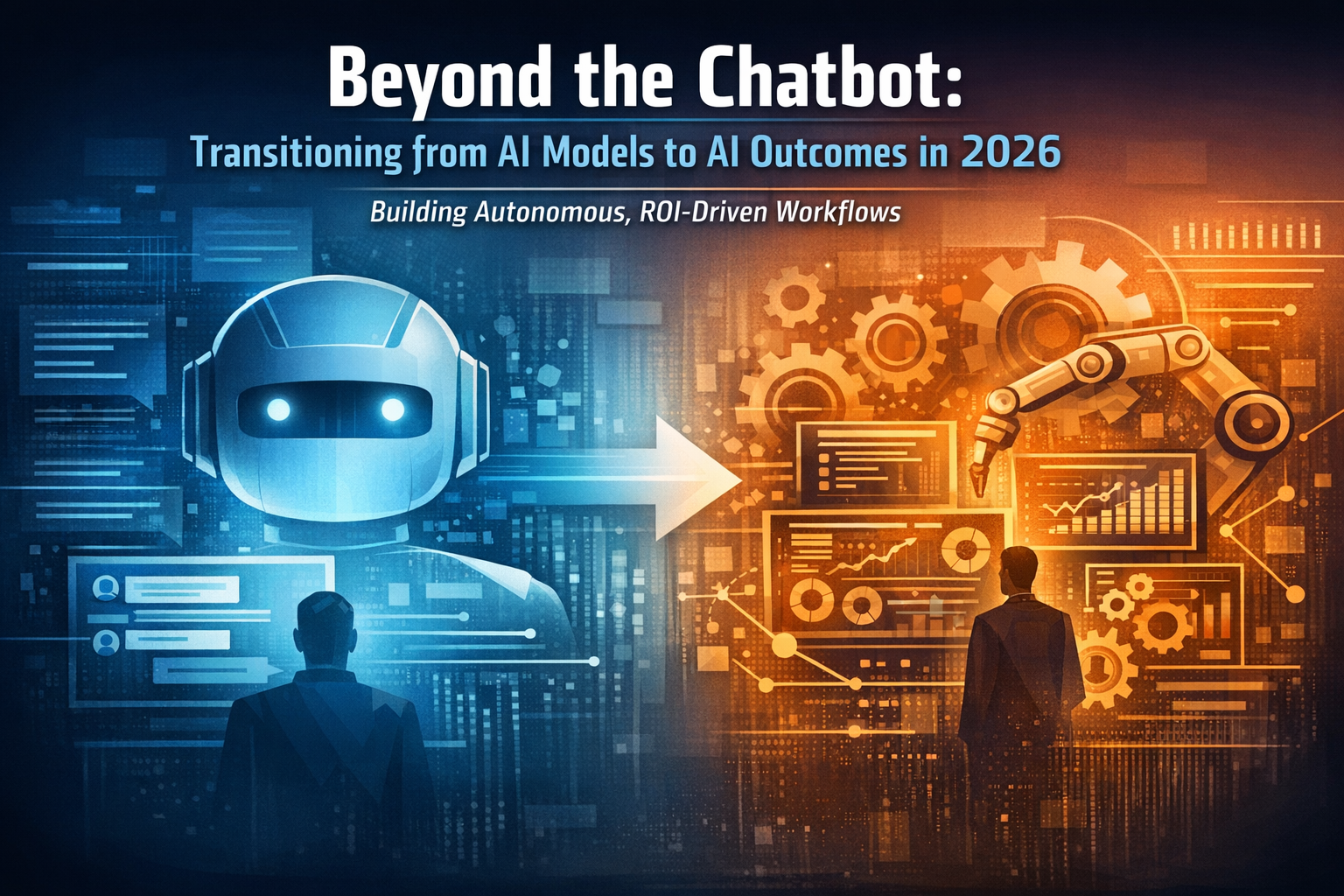
In the early 2020s, the corporate world was obsessed with the “Model.” CEOs asked, “Which LLM are we using?” and boards of directors tracked how many employees had access to ChatGPT. It was a gold rush of experimentation, characterized by a “wait and see” approach to ROI. Organizations raced to adopt tools before fully understanding how those tools would integrate into the business or create measurable value.
But as we move through 2026, the honeymoon phase is over. The novelty of a bot that can write an email or summarize a meeting has worn thin. For operations and data leaders, the conversation has shifted fundamentally. We are no longer in the era of Models; we are in the era of Outcomes. The question is no longer what AI can generate, but what it can complete, accelerate, or eliminate entirely within the business.
If your AI strategy is still centered on which model you’re calling via API, you’re already behind. The winners this year are those who have stopped treating AI as a “digital intern” and started treating it as a core component of their operational fabric. In these organizations, AI is no longer an assistant sitting on the sidelines; it is embedded directly into workflows, quietly executing tasks that once required human coordination.
The Death of “Pilot Purgatory”
For the past few years, many organizations found themselves stuck in “Pilot Purgatory”—a state where AI projects look impressive in a sandbox but fail to provide measurable value when deployed at scale. These pilots often generate excitement internally, but that excitement rarely translates into sustained adoption or meaningful operational change.
The reason is simple: a preoccupation with the tool rather than the task. Teams became focused on what the model could do instead of what the business actually needed done. As a result, AI initiatives remained isolated experiments instead of becoming integrated systems.
In 2026, a “Model-First” approach is a liability. It leads to fragmented tech stacks, high token costs with little return, and “AI fatigue” among staff. Employees begin to see AI as another tool they are expected to use rather than a system that meaningfully improves how work gets done.
An “Outcome-First” approach, however, starts with a cold, hard look at the operational bottleneck. It asks: “What specific metric—be it order processing time, churn rate, or supply chain latency—are we moving?” This shift forces clarity. It aligns AI initiatives with business performance rather than experimentation and ensures that every deployment is tied to a measurable outcome.
The Three Pillars of Outcome-Driven AI
To move from “playing with AI” to “running on AI,” your consultancy needs to focus on three distinct shifts in strategy.
1. From Chatbots to Agentic Workflows
The biggest architectural shift of 2026 is the rise of Agentic AI.
A standard chatbot is reactive; it waits for a prompt. An Agentic Workflow is proactive. It is a system designed to use tools, reason through multi-step problems, and self-correct. This distinction is not just technical—it is operational. It represents the difference between supporting work and completing it.
The Model-First Way: A customer service bot that answers FAQs using a knowledge base.
The Outcome-First Way: An AI Agent that receives a refund request, checks the shipping status in the ERP, verifies the customer’s loyalty tier in the CRM, calculates the lifetime value risk, and either issues the refund or routes it to a human with a pre-written summary of the case.
The outcome isn’t “a conversation”; the outcome is a resolved ticket with zero human touchpoints.
What makes this shift so powerful is its compounding effect. Once one workflow is automated end-to-end, the same architecture can be applied to adjacent processes. Over time, organizations begin to build a network of autonomous workflows that operate continuously in the background, reducing friction across the entire business.
2. The “Data-Centric” Operations Layer
You cannot have high-performance AI outcomes on low-performance data. We’ve moved past the “Garbage In, Garbage Out” era into the “Fragmented In, Hallucination Out” era. The issue is no longer just data quality—it is data accessibility and context.
To drive outcomes, your data needs to be “Agent-Ready.” This means:
Vectorized Context: Moving beyond SQL databases to hybrid systems where AI can “understand” the relationship between disparate data points. This allows agents to pull in relevant information across systems without requiring rigid queries.
Real-Time Governance: Ensuring that as AI agents make decisions, they are doing so within the bounds of current compliance and security protocols. Governance must be embedded directly into the workflow, not layered on afterward.
Operational Lineage: If an AI agent makes a decision, can you trace exactly which piece of data led to that outcome? In 2026, auditability is a non-negotiable requirement for legitimacy. Organizations must be able to explain decisions not just for compliance, but for trust within their own teams.
Without this foundation, even the most advanced AI systems will produce inconsistent and unreliable results.
3. Closing the “Last Mile” of Implementation
The hardest part of operations isn’t the technology—it’s the integration. The “Last Mile” is where AI meets your legacy systems and your human team. This is where most initiatives stall, not because the AI is incapable, but because it cannot connect to the systems where real work happens.
Outcome-driven consultancy focuses on Interoperability. It’s about building the “connective tissue” between the LLM and your proprietary software. If the AI can’t talk to your 10-year-old inventory management system, it’s just an expensive toy.
True implementation requires more than plugging in an API. It requires rethinking how systems interact, standardizing processes, and ensuring that AI can both retrieve and act on information. When this is done correctly, AI becomes invisible—it simply becomes part of how the business operates.
The ROI Math: How to Measure AI Success in 2026
If you are a COO or a VP of Operations, your “Outcome” dashboard should look different than it did two years ago. We are no longer measuring “Time Saved per Employee.” We are measuring impact at the system level.
Autonomous Resolution Rate (ARR): What percentage of a workflow was completed from start to finish without human intervention? This metric reflects true automation, not assistance.
Accuracy-at-Scale: How has the error rate in data entry or logistics forecasting changed since the deployment of agentic reasoning? AI should not only handle more work—it should handle it more reliably.
Capacity Creation: Instead of reducing headcount, how much more volume can your current team handle because the “drudge work” has been automated? This is where AI drives growth, not just efficiency.
These metrics tie directly to revenue, cost control, and operational resilience. They move AI out of the realm of experimentation and into the core of business performance.
Why Now? The Urgency of 2026
The market is bifurcating. There are companies that are becoming “AI-Native” in their operations, and there are those still trying to “bolt on” AI to old ways of working. The gap between these two groups is widening quickly.
The “Model” is now a commodity. Whether you use GPT-5, Claude 4, or a specialized open-source Llama variant, the intelligence is cheap. The value is in the orchestration. It’s in the data pipeline. It’s in the custom-built agents that know your business rules better than your newest hire.
Organizations that fail to make this transition risk more than inefficiency—they risk irrelevance. As competitors begin to operate with faster, more autonomous systems, traditional processes will struggle to keep pace.
Conclusion: The Path Forward
Your business doesn’t need a better chatbot. It needs better outcomes.
As an operations and data consultancy, our role is to stop the fascination with the “shiny object” and start the hard work of operationalizing intelligence. This means identifying bottlenecks, redesigning workflows, integrating systems, and measuring results that matter.
The transition from Models to Outcomes is the defining challenge of this year. Those who master it won’t just save money; they will redefine what it means to be an efficient, data-driven organization. Over time, the organizations that succeed will not be the ones with the most advanced models, but the ones with the most effective systems—systems where intelligence is embedded, actions are automated, and outcomes are consistently delivered.