
From Chaos to Clarity: How to Build Scalable Operational Systems

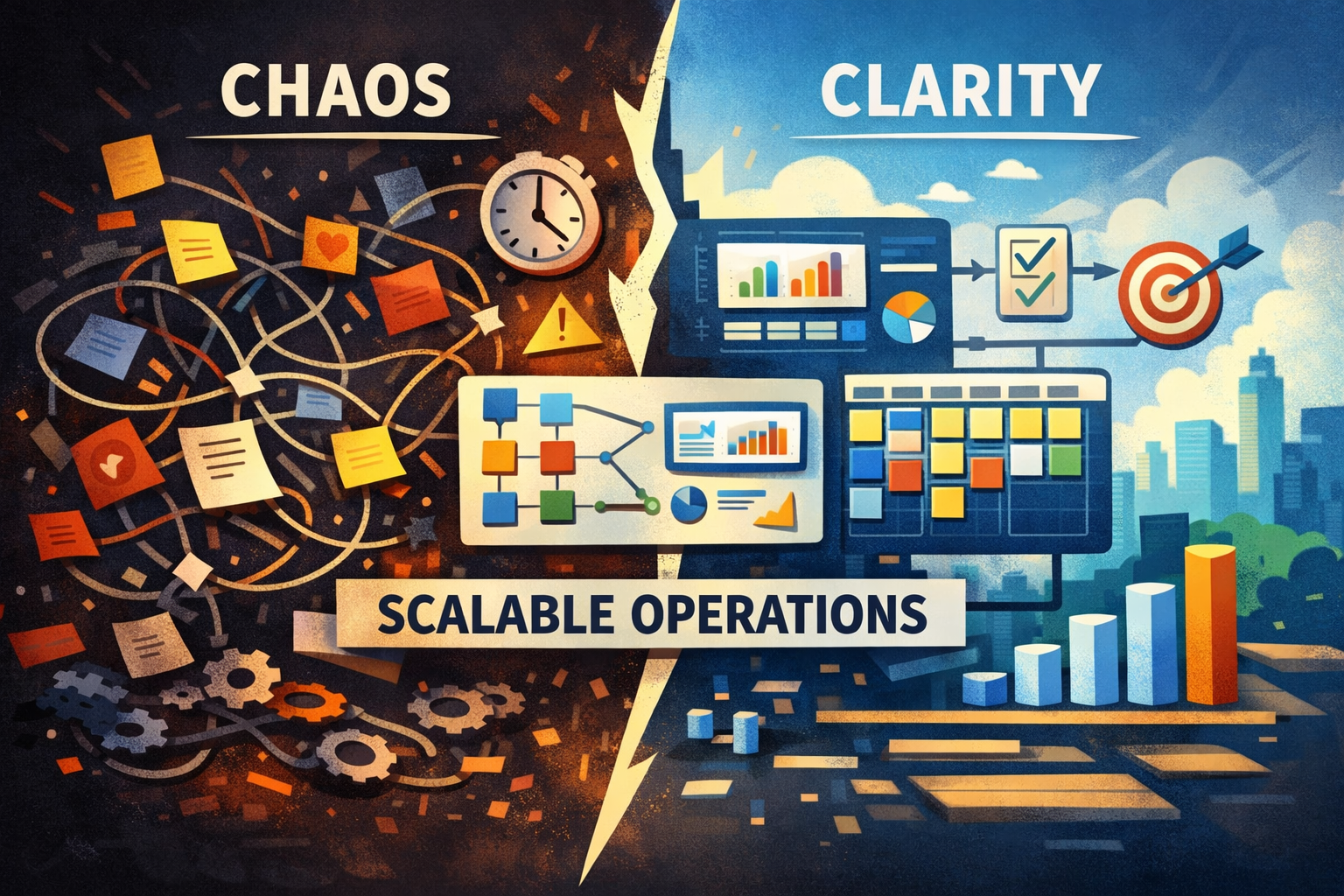
Growth creates complexity.
At first, it’s manageable.
A few spreadsheets. A handful of tools. A small team coordinating through Slack and quick meetings. Everyone knows what’s going on, and problems are solved as they arise.
But as the business grows, something changes.
Processes become inconsistent. Data becomes fragmented. Teams start operating in silos. Reporting takes longer. Decisions become slower. And what once felt agile now feels chaotic.
This transition is not a failure.
It’s a signal.
It means your business has outgrown informal operations—and now requires systems.
The companies that recognize this early build scalable infrastructure and continue growing efficiently.
The ones that don’t end up stuck in operational bottlenecks, where growth creates friction instead of leverage.
The difference comes down to one thing:
Operational design.
What “Operational Chaos” Actually Looks Like
Operational chaos doesn’t usually feel dramatic.
It shows up in subtle, everyday inefficiencies that compound over time.
You might notice:
- Reporting requires manual work every week or month
- Different teams use different numbers for the same metrics
- Customer data exists in multiple systems with inconsistencies
- Processes depend heavily on specific individuals
- Workflows change depending on who is handling the task
- Teams spend more time coordinating than executing
Individually, these issues seem manageable.
Collectively, they create drag across the entire organization.
The result is a business that is growing—but not efficiently.
Why Growing Companies Drift Into Chaos
Operational chaos is not accidental. It’s a natural byproduct of growth.
Most companies start with speed as the priority.
Early on, it makes sense to:
- Move quickly
- Use flexible tools
- Solve problems as they arise
- Prioritize execution over structure
This approach works—until it doesn’t.
As complexity increases, the same behaviors that enabled growth begin to limit it.
There are three common drivers behind this shift.
Speed Without Structure
Early decisions are optimized for speed, not scalability.
Processes are created informally and evolve organically. Documentation is minimal. Systems are chosen based on immediate needs rather than long-term integration.
Over time, these decisions accumulate.
What started as flexibility becomes inconsistency.
Tool Fragmentation
As the business grows, new tools are added:
- CRM systems
- Marketing platforms
- Finance tools
- Support systems
- Analytics platforms
Each tool solves a specific problem.
But without intentional design, they don’t work together.
Data becomes fragmented. Metrics become inconsistent. Teams operate in parallel instead of in alignment.
People-Dependent Systems
In early stages, operations rely heavily on individuals.
Certain team members “just know” how things work. They fill gaps, fix issues, and keep processes moving.
But as the organization grows, this becomes a risk.
When knowledge is not systemized, scalability becomes dependent on people rather than processes.
The Shift: From Reactive Work to Designed Systems
Scaling operations requires a fundamental shift:
From reactive work → to designed systems.
Instead of solving problems as they appear, you build systems that prevent them.
Instead of relying on individuals, you rely on processes.
Instead of fragmented tools, you create integrated infrastructure.
This shift does not happen automatically.
It requires intentional design.
What Scalable Operational Systems Actually Mean
Scalable systems are not about complexity.
They are about clarity.
A well-designed operational system has:
- Defined workflows
- Clear ownership
- Consistent data
- Integrated tools
- Standardized processes
- Reliable reporting
It allows the business to handle increased volume without increasing friction.
It enables teams to move faster—not slower—as the company grows.
A Practical Framework for Building Scalable Operations
Building scalable systems does not require a complete overhaul overnight.
It requires structured thinking and incremental improvement.
Map Your Core Workflows
Start by identifying the processes that drive your business.
These typically include:
- Lead generation and sales pipeline
- Customer onboarding
- Service delivery or product fulfillment
- Financial reporting
- Performance tracking
For each workflow, document:
- Inputs (where work starts)
- Steps (what happens)
- Outputs (what is delivered)
- Dependencies (what systems or teams are involved)
This exercise alone often reveals inefficiencies, duplication, and gaps.
Define Ownership and Accountability
Every process should have clear ownership.
Without ownership:
- Tasks fall through the cracks
- Issues go unresolved
- Systems degrade over time
Ownership doesn’t mean doing all the work.
It means being responsible for:
- Process performance
- Continuous improvement
- Issue resolution
Clarity in ownership reduces confusion and increases accountability across teams.
Standardize Processes
Variation is one of the biggest sources of operational inefficiency.
When the same task is performed differently across teams or individuals, outcomes become inconsistent.
Standardization creates predictability.
This includes:
- Defined steps for recurring processes
- Clear criteria for decision-making
- Consistent documentation
- Agreed-upon workflows
Standardization does not remove flexibility.
It creates a baseline that can be improved over time.
Build a Single Source of Truth for Data
Data fragmentation is one of the most common causes of operational friction.
When different systems produce different numbers, trust breaks down.
To fix this, define:
- Where each key metric lives
- How it is calculated
- Which system is authoritative
Examples of key metrics include:
- Revenue
- Customer count
- Churn
- Pipeline value
- Conversion rates
Consistency matters more than perfection.
Once a single source of truth is established, decision-making becomes faster and more reliable.
Integrate Your Systems
Disconnected tools create manual work.
Teams end up:
- Copying data between systems
- Reconciling inconsistencies
- Managing multiple versions of the same information
Integration reduces this friction.
This can involve:
- Connecting systems through APIs
- Using middleware or automation tools
- Building centralized data pipelines
The goal is simple:
Data should flow automatically, not manually.
Eliminate Repetitive Manual Work
Any task that is repeated regularly should be evaluated.
Ask:
- Can this be automated?
- Can this be simplified?
- Can this be removed entirely?
Examples include:
- Report generation
- Data entry
- Status updates
- Notifications
- Data reconciliation
Reducing manual work increases efficiency and reduces error rates.
Design for Visibility
Operational clarity requires visibility.
Leadership and teams should be able to quickly understand:
- What is happening
- Where issues exist
- How performance is trending
This is achieved through:
- Clear dashboards
- Consistent reporting
- Defined KPIs
Visibility reduces guesswork and enables faster decision-making.
The Role of Systems in Scaling
As a business grows, volume increases.
More customers. More transactions. More data. More complexity.
Without systems, this leads to:
- More work
- More errors
- More coordination
With systems, it leads to:
- More leverage
- Faster execution
- Better outcomes
This is the difference between growth that feels heavy and growth that feels scalable.
Common Mistakes to Avoid
Building operational systems is not just about what to do—it’s also about what to avoid.
Overengineering Too Early
Not every process needs a complex system.
Focus on:
- High-impact areas
- Repetitive workflows
- Bottlenecks
Start simple and evolve.
Ignoring Adoption
A system only works if people use it.
Ensure that:
- Processes are easy to follow
- Tools are intuitive
- Teams understand the value
Adoption is as important as design.
Solving Problems with Tools Alone
New tools do not fix broken processes.
Without clear workflows and data structure, tools add complexity instead of reducing it.
Design first. Then implement tools.
Failing to Revisit Systems
Operations are not static.
As the business evolves, systems must evolve with it.
Regularly review:
- Process effectiveness
- Data accuracy
- System performance
Continuous improvement is key to long-term scalability.
The Competitive Advantage of Operational Clarity
Companies that build strong operational systems gain a significant advantage.
They can:
- Scale faster without increasing headcount proportionally
- Make decisions with confidence
- Reduce errors and inefficiencies
- Improve team performance and morale
- Adapt quickly to change
Operational clarity is not just an internal benefit.
It directly impacts growth, profitability, and long-term sustainability.
Final Thoughts
Every growing company reaches a point where chaos begins to replace clarity.
This is not a failure.
It is a transition point.
A signal that the business has outgrown informal operations and needs structured systems.
The companies that recognize this early build infrastructure that supports scale.
They move from reactive problem-solving to intentional design.
They replace fragmentation with integration.
They turn operations from a source of friction into a source of leverage.
Because in the long run, growth is not limited by opportunity.
It is limited by the systems that support it.
And the companies that build those systems well are the ones that scale with clarity instead of chaos.