
From Process Problem to Working Prototype: How AI Is Changing App Development

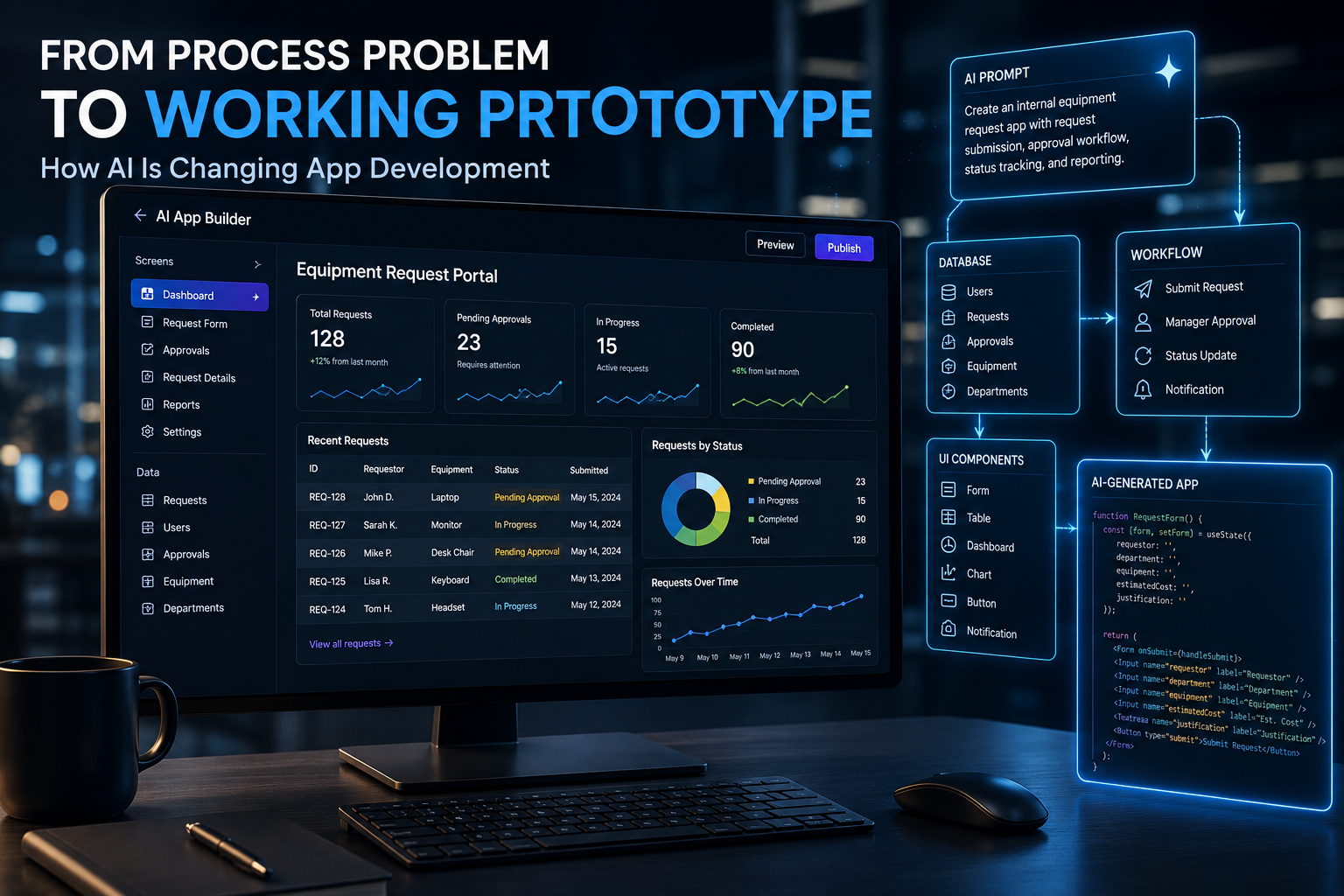
Every organization has a process that works—but only because employees have learned how to work around it.
A request arrives through email.
Someone copies the information into a spreadsheet.
Another employee reviews it.
A manager approves it.
Someone updates the spreadsheet again.
At the end of the month, another employee takes all that information and manually turns it into a report.
Nothing is technically broken. The work gets done.
But ask the people performing that process every day, and they will probably tell you there has to be a better way.
Until recently, there were only a few realistic options.
The organization could continue using the existing process. It could purchase another software platform and try to adapt its workflow around the software. Or it could hire developers to build a custom application—a decision that might require significant time, money, and technical resources.
Artificial intelligence is beginning to introduce another option.
A growing generation of AI-assisted development tools can turn plain-language instructions into working software prototypes. Instead of beginning with code, users can begin by describing the problem they want to solve.
That shift has the potential to change how businesses think about internal software.
But it also introduces an important question:
If building an application becomes dramatically easier, how do we make sure we're building the right thing?
From “We Need Software” to “We Need to Solve a Problem”
Businesses frequently approach technology decisions backward.
A team encounters an operational problem and immediately starts searching for software.
“We need a project management system.”
“We need an inventory platform.”
“We need an approval tool.”
“We need another dashboard.”
But software is not the objective.
Solving the underlying business problem is.
Imagine a company where employees request new equipment by sending an email to their manager.
The manager replies with an approval.
Someone in operations enters the request into a spreadsheet.
Purchasing uses the spreadsheet to place the order.
The employee emails operations asking for updates.
At the end of the month, someone manually creates a report showing outstanding requests.
The organization might conclude that it needs purchasing software.
Maybe it does.
But first, it should define the actual problems:
Requests arrive inconsistently.
Approvals are difficult to track.
Information is entered manually.
Employees cannot see the status of their requests.
Reporting requires additional work.
Once those problems are understood, the technology requirements become much clearer.
The organization doesn't simply need “software.”
It needs a way to collect requests, route approvals, maintain accurate records, communicate status, and report on activity.
That distinction becomes even more important as AI makes applications easier to create.
What AI App Building Changes
Traditional application development generally requires someone who understands programming languages, databases, interfaces, hosting, integrations, security, and other technical components.
That expertise remains extremely important.
But AI is changing how much technical knowledge is required to get from an idea to an initial working prototype.
Instead of writing every component manually, users can increasingly describe what they want in natural language.
For example:
“Create an internal equipment request application. Employees should submit a request with their name, department, equipment requested, estimated cost, and business justification. Requests over $5,000 should require manager approval. Employees should be able to see the status of their request, and managers should have a dashboard showing pending approvals.”
An AI-assisted development platform can use instructions like these to begin generating the application's interface, database structure, forms, logic, and other components.
The first result probably won't be perfect.
But it can provide something extremely valuable:
a working starting point.
Instead of spending weeks discussing what an application might look like, a team may be able to interact with a prototype much sooner.
They can click buttons.
Submit requests.
Look at dashboards.
Identify missing information.
Discover confusing steps.
Ask for changes.
That dramatically shortens the distance between an operational idea and something people can actually test.
Prototyping May Be the Biggest Opportunity
One of the most valuable applications of AI development may not be replacing professional software development.
It may be rapid prototyping.
There is an enormous difference between describing an idea in a meeting and putting something in front of the employees who will actually use it.
Imagine asking a team:
“What information should appear on the request screen?”
You might get five different answers.
Now give the same team a working prototype.
Suddenly, the conversation becomes specific.
“We don't need this field.”
“This should be a dropdown.”
“Managers need to see the requested delivery date.”
“Employees shouldn't be able to edit this after approval.”
“We forgot about requests from contractors.”
“This status doesn't make sense.”
The prototype becomes a tool for understanding the process itself.
That can be incredibly valuable.
AI-assisted development allows organizations to test assumptions earlier, before investing heavily in a solution that may not fit the actual workflow.
The People Closest to the Problem Can Participate
Another significant change is who can participate in application development.
Historically, the employee who understood the business problem and the person capable of building the software were often two different people.
An operations employee might understand exactly why a workflow was inefficient but have no ability to create software.
A developer might understand exactly how to build an application but need someone else to explain the workflow.
Information had to move between them.
Requirements documents were created.
Meetings were scheduled.
Mockups were reviewed.
Changes were requested.
Some information inevitably got lost in translation.
AI-assisted development can reduce that distance.
The person who understands the process can participate much more directly in creating and refining the prototype.
That does not eliminate the need for technical expertise.
It changes where that expertise becomes necessary.
Instead of requiring a developer to create every early concept, technical teams can spend more time evaluating architecture, security, integrations, reliability, scalability, and the difficult problems that actually require their expertise.
Small Operational Problems Suddenly Become Worth Solving
This may be one of the biggest business implications of AI app building.
Organizations contain countless small process problems that are frustrating but never quite important enough to justify a traditional software project.
A spreadsheet requires too much manual updating.
A department tracks requests through email.
Managers maintain separate lists of the same information.
Employees cannot easily find the status of a task.
Someone spends several hours every month combining data into a report.
A small team needs a simple scheduling or tracking tool.
Historically, the response might have been:
“It's annoying, but building something isn't worth it.”
That calculation changes when the cost and time required to create a prototype decrease.
Suddenly, organizations can explore solutions to smaller problems.
An internal tool does not necessarily need thousands of users or hundreds of features.
Sometimes it simply needs to make one process significantly better.
A Simple App Can Create Significant Value
Consider an organization managing inspections through email and spreadsheets.
Employees conduct inspections and email their findings.
Someone manually enters the results into a spreadsheet.
Photos are stored separately.
Managers periodically review the spreadsheet to identify unresolved issues.
Creating a traditional enterprise inspection platform may be unnecessary.
But a simple internal application could potentially provide:
Inspection form → photo upload → centralized record → issue assignment → status tracking → management dashboard
That isn't revolutionary technology.
The value comes from removing friction.
Information is captured once.
Everyone works from the same record.
Managers have visibility.
Employees know what requires action.
Reporting becomes easier.
Small improvements like these can compound across an organization.
But Easy to Build Does Not Mean Ready for Business
This is where organizations need to be careful.
An application that looks impressive after an afternoon of AI-assisted development is not necessarily ready to become part of a company's critical operations.
A prototype and a production system are two very different things.
Before relying on an AI-built application, businesses need to consider several questions.
Where Does the Data Live?
What information will the application collect?
Where is it stored?
Who has access?
Does it contain customer information, employee information, financial data, intellectual property, or other sensitive material?
Data decisions should not be an afterthought.
Who Can Access What?
A simple internal application may quickly become more complicated when permissions are considered.
Employees may need to see their own requests.
Managers may need to see their department.
Executives may need company-wide reporting.
Administrators may need editing capabilities.
External users may need limited access.
Good access control requires deliberate design.
What Happens When Something Breaks?
If an application becomes part of everyday operations, someone needs to own it.
Who fixes it?
Who updates it?
Who understands how it works?
What happens if the AI platform changes?
What happens when the company's process changes six months later?
Creating software is only the beginning of its lifecycle.
What Does It Need to Connect With?
Few business applications operate completely independently.
An internal application may eventually need information from a CRM, ERP, accounting platform, inventory system, HR system, data warehouse, or another business application.
Integrations can quickly turn a simple prototype into a much more serious technical project.
Can the Organization Depend on It?
There is a major difference between an application used by five employees to track internal requests and an application responsible for billing customers or controlling a manufacturing process.
The greater the business impact, the greater the need for testing, monitoring, security, governance, and professional technical oversight.
Don't Automate a Bad Process
There is another danger.
AI makes it easier to build applications quickly.
That also makes it easier to build applications around processes that should never have existed in the first place.
Suppose a purchasing process requires six approvals.
Someone might build an application that automatically routes every request through all six people.
The application works perfectly.
But what if only two approvals were actually necessary?
The organization has successfully automated inefficiency.
Before building an application, ask:
Why does this process exist?
Which steps actually create value?
Which steps exist because of an old system or policy?
Where does information get duplicated?
Which decisions require human judgment?
Which activities could be eliminated entirely?
The best application may be much simpler than the original process suggests.
Sometimes the greatest improvement comes from removing steps before automating what remains.
Avoid Creating a New Kind of App Sprawl
AI development introduces another potential problem.
If everyone can build an application, eventually everyone may build an application.
Marketing creates one.
Operations creates three.
Finance creates another.
A regional office builds its own version.
Six months later, the organization has dozens of small applications containing overlapping information.
Nobody knows which one is authoritative.
Security policies differ.
Data is duplicated.
Some applications are no longer maintained.
The organization has recreated the same technology problem it was trying to solve.
This is why governance matters even when development becomes easier.
Organizations should establish basic standards around:
- Who can create internal applications
- What platforms can be used
- What data can be stored
- When IT or security needs to review an application
- How applications are documented
- Who owns each application
- How integrations are approved
- When an application should be retired
AI can democratize software creation without turning application development into a free-for-all.
Build or Buy Is Becoming a Different Question
For decades, organizations have faced a familiar technology decision:
Should we build software ourselves or buy an existing product?
AI doesn't eliminate that question.
It changes the economics around it.
Buying established software still makes sense when the business needs mature functionality, proven security, compliance capabilities, ongoing vendor support, complex integrations, or features that would be expensive to recreate.
There is little reason to build a custom accounting system simply because AI can generate code.
But the calculation may be different for a narrow internal workflow unique to the organization.
The future may involve more combinations:
Buy the major systems that run the business.
Configure platforms when existing functionality can meet the need.
Integrate systems when information needs to move between them.
Automate repetitive steps.
And build lightweight applications when a specific operational problem does not justify purchasing another large platform.
AI expands the number of situations where that last option becomes realistic.
Start With One Annoying Process
Organizations interested in AI app building do not need to begin with an ambitious enterprise application.
Start smaller.
Find one process employees regularly describe as frustrating.
Something involving:
- Repetitive data entry
- Email-based requests
- Spreadsheet tracking
- Manual approvals
- Status inquiries
- Recurring reports
- Disconnected information
- Simple scheduling
- Document collection
- Task assignment
Map the process as it works today.
Identify what information enters the process.
Determine who makes decisions.
Find the unnecessary steps.
Then describe what a better experience would look like.
Only after that should you start building.
Create a prototype.
Put it in front of the people who actually perform the work.
Watch how they use it.
Ask what is missing.
Identify what doesn't make sense.
Improve it.
Then decide whether the application deserves to become something the business actually relies on.
The Hard Part Is Changing
For years, the difficult part of custom software was often creating the software itself.
AI is beginning to reduce that barrier.
But that does not mean business transformation becomes automatic.
Organizations still need to understand their processes.
They still need clean and accessible data.
They still need employees to adopt new ways of working.
They still need security and governance.
They still need to decide which problems are worth solving.
And they still need someone to ask the most important question:
What are we actually trying to improve?
AI can help turn an idea into a working prototype faster than ever before.
That is powerful.
But speed only creates value when it is pointed in the right direction.
The opportunity isn't simply that businesses can build more applications.
It's that they can experiment faster, learn sooner, and create tools that fit the way their organizations actually need to work.
The ability to build is becoming easier.
Knowing what is worth building may become the real competitive advantage.