
How AI Is Transforming Business Operations in 2026

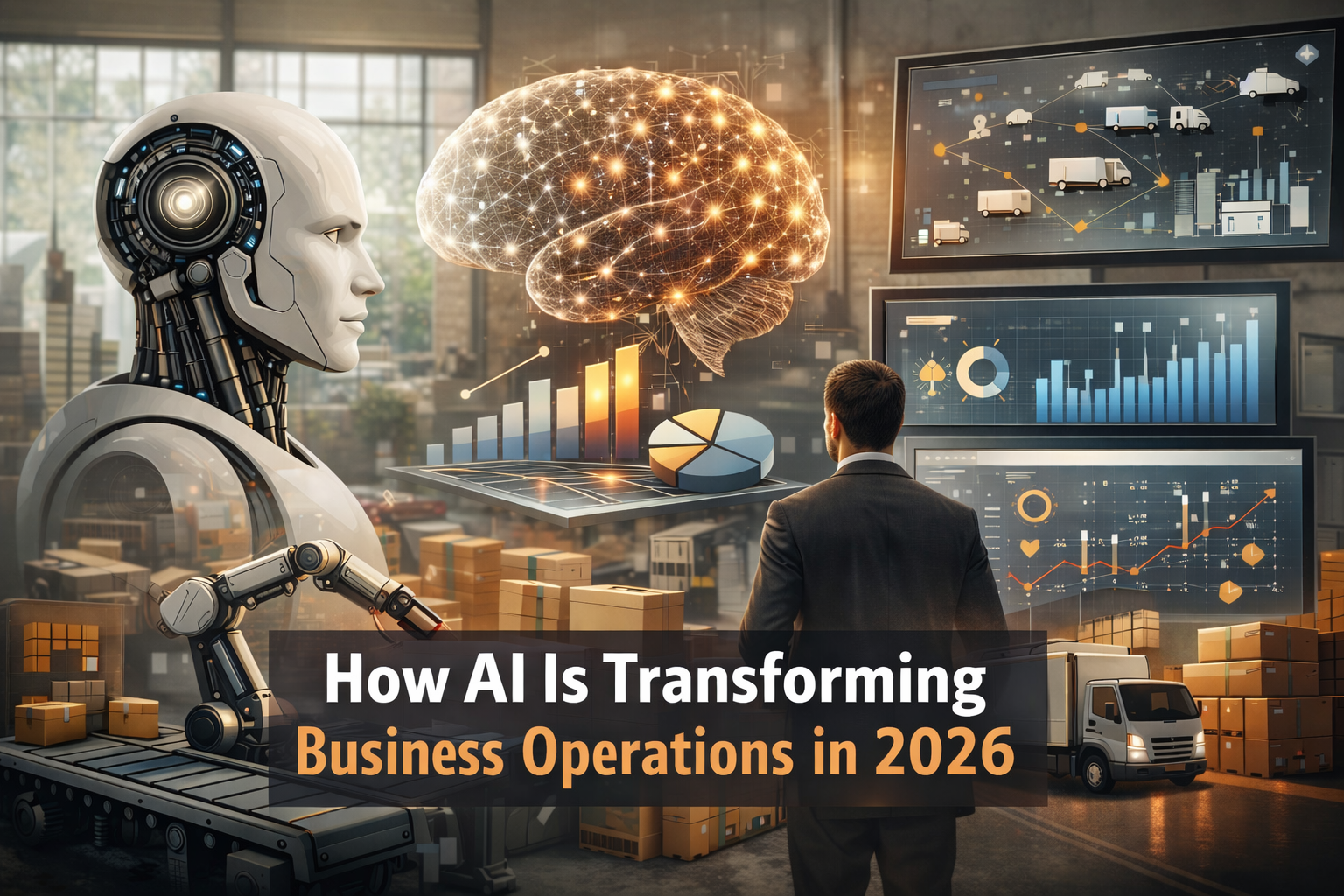
Artificial intelligence has moved beyond being a buzzword. In 2026, it is rapidly becoming a practical tool that businesses are using to improve how they operate, make decisions, and scale their organizations.
For many companies, operations management has traditionally relied on a mix of spreadsheets, manual reporting, and fragmented systems. While these tools helped businesses run effectively in the past, they often limit visibility, slow decision-making, and create unnecessary operational complexity.
AI is beginning to change that.
From forecasting demand to automating workflows and improving data analysis, artificial intelligence is reshaping how companies manage their day-to-day operations. Businesses that learn how to integrate AI into their operational systems are gaining a significant advantage in efficiency, scalability, and insight.
In this article, we explore how AI is transforming business operations in 2026 and how organizations can begin adopting it in practical ways.
Why Operations Management Is Changing
Operations management has always been about one central goal: improving efficiency while maintaining quality and reliability.
Historically, organizations achieved this through process optimization, standardized procedures, and careful performance tracking. However, these methods often required significant manual oversight.
Teams spent hours every week:
- Updating spreadsheets
- Generating reports
- Analyzing performance metrics
- Coordinating across disconnected systems
As businesses grow, these manual processes become increasingly difficult to manage. Information becomes scattered across tools, decision cycles slow down, and teams spend more time maintaining systems than improving them.
AI changes this dynamic by introducing systems that can analyze, automate, and optimize operations in real time.
Instead of reacting to operational issues after they occur, companies can begin predicting and preventing them.
The Rise of AI-Driven Operations
AI-driven operations rely on the integration of data, analytics, and automation into everyday business workflows.
These systems combine several technologies:
- machine learning models
- predictive analytics
- automation tools
- data integration platforms
Together, they allow organizations to process large volumes of information and generate insights that were previously difficult or impossible to obtain.
The result is a shift from manual operational oversight to intelligent operational systems.
Rather than asking teams to constantly monitor performance, AI systems can detect patterns, highlight anomalies, and recommend improvements automatically.
Key Ways AI Is Transforming Business Operations
Artificial intelligence is influencing operations in several important ways. While the specific applications vary by industry, a few core patterns are emerging across organizations.
1. Smarter Forecasting
Forecasting has always been one of the most challenging aspects of operations management.
Traditional forecasting methods often rely on historical trends combined with human judgment. While these methods can work reasonably well, they struggle to adapt quickly to changing conditions.
AI models improve forecasting by analyzing significantly larger datasets and identifying patterns that humans may miss.
Examples include:
- demand forecasting in retail and supply chains
- revenue projections in finance
- customer behavior prediction in marketing
- resource planning in operations
AI-driven forecasting systems can incorporate variables such as seasonality, economic trends, customer behavior, and historical performance simultaneously.
This allows businesses to make more accurate predictions and plan their operations more effectively.
2. Workflow Automation
One of the most immediate benefits of AI in operations is workflow automation.
Many operational tasks involve repetitive processes that require manual input, such as:
- generating reports
- updating operational dashboards
- reconciling data between systems
- processing internal requests
AI-powered automation tools can handle many of these tasks automatically.
For example, instead of manually generating weekly reports, organizations can implement systems that:
- collect data from multiple sources
- analyze performance metrics
- generate reports automatically
- distribute insights to relevant teams
This reduces the time spent on routine administrative tasks and allows employees to focus on higher-value activities.
3. Real-Time Operational Insights
Many companies struggle with delayed operational insights.
By the time a weekly or monthly report is produced, the underlying situation may already have changed. This lag makes it difficult for leadership teams to respond quickly to operational challenges.
AI-powered analytics platforms can provide real-time insights into operational performance.
These systems continuously monitor data streams and highlight important trends as they emerge.
For example, AI systems can detect:
- sudden changes in customer demand
- operational bottlenecks
- supply chain disruptions
- performance anomalies
Instead of waiting for a report, teams receive immediate alerts and insights that help them respond more quickly.
4. Process Optimization
AI can also help identify inefficiencies within operational processes.
By analyzing large datasets that capture how work actually happens inside an organization, AI systems can identify patterns that reveal inefficiencies.
These insights might highlight:
- redundant steps in workflows
- delays between operational stages
- underutilized resources
- opportunities for automation
Over time, organizations can use these insights to continuously refine their processes and improve overall efficiency.
5. Decision Support for Leadership
Leadership teams often face complex decisions involving multiple variables.
For example:
- When should we increase production?
- Where should we allocate resources?
- Which markets show the most growth potential?
AI-driven decision-support systems help leaders answer these questions by analyzing relevant data and presenting insights in clear formats.
These systems do not replace human judgment. Instead, they enhance it by providing deeper analytical context.
Executives can make faster, more informed decisions because they have access to better information.
Why Data Infrastructure Matters
While AI offers tremendous potential, its effectiveness depends heavily on the quality of an organization’s data infrastructure.
Many businesses struggle to implement AI because their data is fragmented across spreadsheets, legacy systems, and disconnected tools.
Without reliable and structured data, AI systems cannot generate meaningful insights.
Organizations that want to leverage AI successfully must first ensure that they have:
- centralized data systems
- clean and consistent datasets
- integrated operational platforms
Building this foundation allows AI systems to analyze information effectively and generate accurate insights.
Practical Steps for Businesses Exploring AI
For organizations interested in adopting AI in their operations, the process does not need to begin with large-scale transformation projects.
Instead, many companies find success by starting with targeted improvements.
Here are a few practical steps businesses can take.
Identify Operational Bottlenecks
Start by examining where teams spend the most time on repetitive or manual tasks.
These areas often represent the best opportunities for AI-driven automation.
Centralize Key Data Sources
Bringing operational data into a unified environment helps eliminate inconsistencies and prepares the organization for AI-driven analytics.
Implement Automated Reporting
Replacing manual reports with automated dashboards is often one of the easiest and most impactful improvements.
Experiment with AI Tools
Many AI tools are now accessible through cloud platforms and integrated business software.
Organizations can begin experimenting with these tools in specific operational areas before expanding their use.
The Future of AI in Operations
The role of AI in operations will continue to grow over the next decade.
As AI tools become more accessible and easier to integrate, businesses of all sizes will begin incorporating intelligent systems into their workflows.
Several trends are already emerging:
- AI-driven planning and forecasting
- automated operational monitoring
- predictive supply chain management
- intelligent resource allocation
These capabilities will allow organizations to operate with greater agility and efficiency.
Rather than reacting to operational challenges after they occur, companies will increasingly rely on predictive insights that allow them to anticipate and address issues proactively.
Final Thoughts
Artificial intelligence is not replacing operations management. Instead, it is enhancing it.
By combining human expertise with intelligent systems, businesses can improve efficiency, gain deeper insights, and make better decisions.
Organizations that embrace AI-driven operations today are positioning themselves to operate more effectively in an increasingly data-driven economy.
The companies that succeed in the coming years will not necessarily be the ones with the most technology. They will be the ones that learn how to integrate AI thoughtfully into their operational systems and use it to support smarter decision-making.
In 2026 and beyond, AI is becoming a core component of modern business operations—and the organizations that adapt early will have a powerful advantage.