
Operational Debt: The Hidden Cost Slowing Down Growing Companies

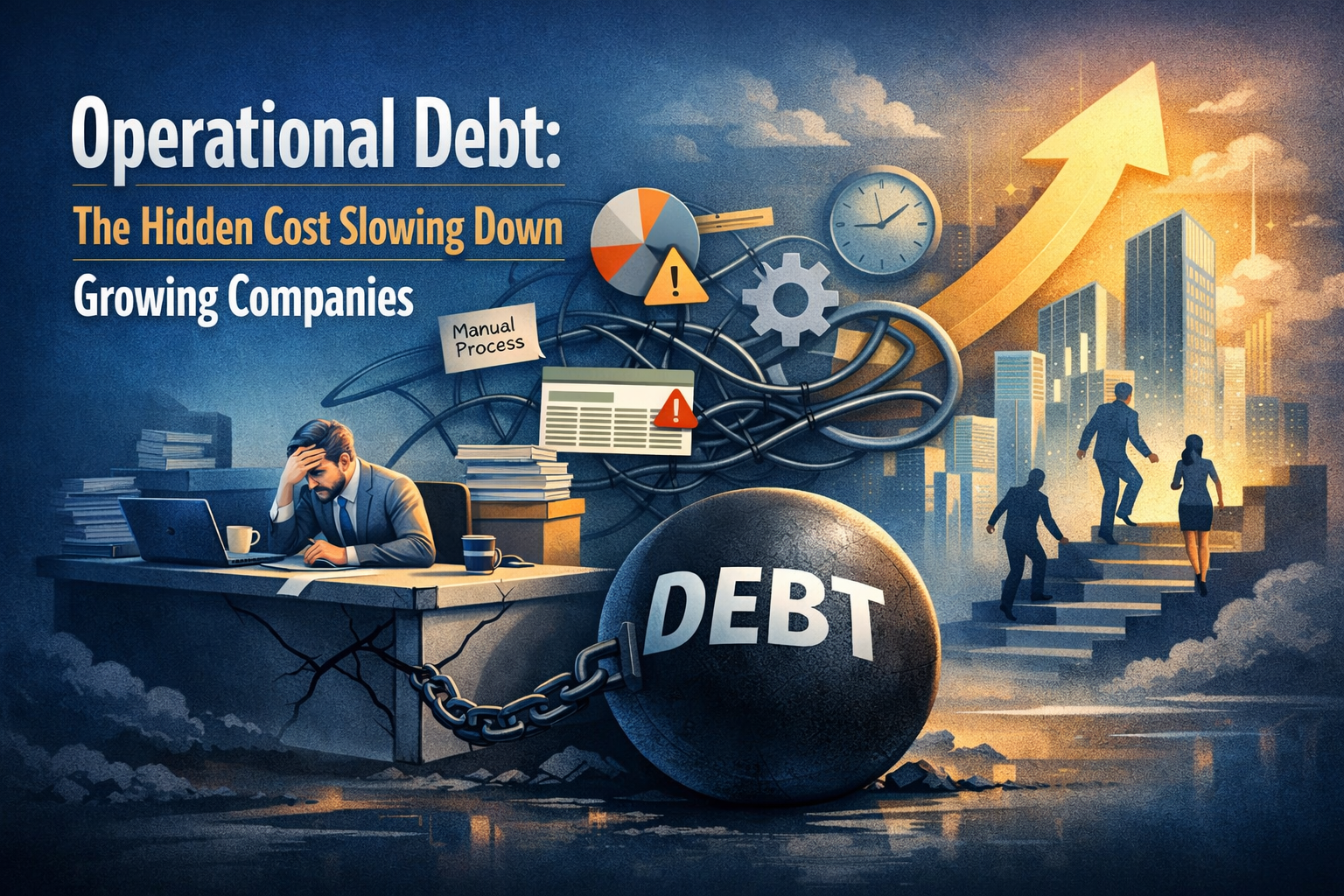
Growth feels good.
Revenue increases. New hires come in. Customers multiply. Product lines expand. Leadership starts talking about “scale.”
But behind the scenes, something else often grows faster than revenue:
Operational debt.
Unlike financial debt, operational debt doesn’t show up on a balance sheet. It doesn’t trigger alerts from your accountant. It doesn’t appear in board reports.
But it silently compounds.
It slows decisions.
It increases risk.
It drains margin.
It frustrates teams.
And eventually, it caps growth.
If your company feels busier than ever but not proportionally more efficient, operational debt may be the reason.
Let’s unpack what it is, how it accumulates, and how to systematically eliminate it.
What Is Operational Debt?
Operational debt is the accumulated cost of shortcuts, manual processes, disconnected systems, and reactive decisions that were once “good enough” but no longer scale.
It typically includes:
- Spreadsheet-based reporting that should be automated
- Manual data reconciliation between tools
- Slack threads as process documentation
- Tribal knowledge instead of standardized workflows
- Multiple systems that don’t integrate cleanly
- Duplicate data stored across departments
- Ad-hoc analytics instead of governed reporting
None of these are catastrophic in isolation.
But together, they create friction across the entire organization.
Just like technical debt in software, operational debt is often taken on intentionally — to move fast, launch quickly, or save short-term cost.
The problem is not that it exists.
The problem is when it compounds unnoticed.
How Operational Debt Accumulates
Operational debt rarely appears overnight. It builds gradually in predictable stages.
Early Growth: “We’ll Fix It Later”
In early-stage companies, speed matters more than structure.
Manual reporting? Fine.
Exporting CSVs? Fine.
One operations person managing five systems? Fine.
At this stage, agility beats efficiency.
But if systems aren’t revisited as the company grows, those temporary solutions become permanent constraints.
Tool Proliferation
As teams scale, new tools are introduced:
- CRM for sales
- Marketing automation platform
- Customer success software
- Financial tools
- Data warehouse
- Analytics platform
Each tool solves a problem.
But without intentional architecture, you end up with:
- Redundant data fields
- Conflicting metrics
- Manual integrations
- Shadow workflows
Now the company has tools — but no unified system.
Manual Workarounds Become Standard Practice
Instead of fixing integration gaps, teams create workarounds:
- “Just export the report and email it.”
- “Ops will clean that up.”
- “Finance reconciles it manually every Friday.”
- “We track that in a separate spreadsheet.”
Workarounds feel efficient in the moment.
But they add hidden labor cost and increase error risk.
Decision Lag Increases
Eventually, operational debt starts affecting strategy.
Leadership asks:
- “What’s our real CAC?”
- “Why are churn numbers different in each report?”
- “How long does onboarding actually take?”
- “Why does forecasting keep missing?”
When metrics are unreliable or slow to produce, decision-making slows.
And slow decisions in competitive markets are expensive.
Margin Compression and Burnout
The final stage is where operational debt becomes visible.
- Teams work longer hours.
- Headcount increases without proportional output.
- Revenue grows but margins shrink.
- High performers burn out from repetitive manual tasks.
At this point, operational debt is no longer an inconvenience — it’s a structural drag on the business.
The Real Cost of Operational Debt
Operational debt impacts five core areas.
Financial Cost
Manual processes require labor.
If three team members spend eight hours per week reconciling reports manually, that’s over 1,200 hours per year — easily six figures in hidden labor cost.
And that’s before factoring in error correction.
Strategic Blind Spots
Disconnected data leads to misaligned KPIs.
When sales, marketing, finance, and operations all report slightly different numbers, leadership loses confidence in dashboards.
Decisions become opinion-driven instead of data-driven.
Slower AI Adoption
Many companies want to “implement AI.”
But AI systems require:
- Clean data
- Structured workflows
- Defined processes
- Consistent metrics
If your operational foundation is fragmented, AI simply amplifies chaos.
Operational debt must be reduced before intelligent systems can be layered on top.
Employee Frustration
High-performing employees don’t want to:
- Copy data between systems
- Chase down numbers
- Rebuild reports every month
- Compensate for broken workflows
Operational friction erodes morale over time.
Scaling Risk
Manual systems can survive at $5M revenue.
They collapse at $25M.
Operational debt compounds as transaction volume increases.
What worked at 1,000 customers fails at 10,000.
Signs Your Company Has Significant Operational Debt
Common indicators include:
- Reporting takes days instead of minutes
- You don’t fully trust your dashboards
- Multiple departments define the same metric differently
- Onboarding requires excessive human coordination
- Forecasting consistently misses
- Customer data exists in multiple inconsistent versions
- You rely heavily on “that one person” who knows how things work
If several of these apply, operational debt is likely constraining growth.
Why AI Doesn’t Fix Operational Debt (It Exposes It)
There’s a common misconception:
“AI will solve our inefficiencies.”
In reality, AI systems magnify structural weaknesses.
If your inputs are inconsistent, your outputs will be unreliable.
If your processes aren’t documented, AI can’t augment them effectively.
If your data model isn’t standardized, machine learning models won’t perform accurately.
AI is a multiplier.
It multiplies clarity — or it multiplies chaos.
A Framework for Reducing Operational Debt
Eliminating operational debt isn’t about buying new software.
It’s about structured system design.
Map Core Workflows
Document:
- Revenue lifecycle (lead → close → renewal)
- Financial reporting process
- Customer onboarding
- Product release workflow
- Forecasting process
Identify manual steps, duplications, and system handoffs.
Most operational friction hides at integration points.
Define a Single Source of Truth
Choose where each critical metric lives:
- Revenue
- CAC
- Churn
- MRR
- Pipeline value
- Customer health
If multiple systems generate competing numbers, establish hierarchy.
Consistency matters more than perfection.
Eliminate Manual Reconciliation
Any recurring manual process should be evaluated for:
- Automation via workflow tools
- API integration
- Data pipeline creation
- Dashboard consolidation
If a task repeats weekly or monthly, it should not require manual assembly.
Standardize Metrics and Definitions
Operational clarity requires shared language.
Define:
- What counts as a qualified lead
- What counts as an active customer
- What defines churn
- What defines revenue recognition
Ambiguity fuels operational debt.
Introduce Intelligent Automation (After Cleanup)
Only after workflows are structured should you layer in:
- AI forecasting
- Automated anomaly detection
- Intelligent routing
- Predictive customer health scoring
- Automated reporting generation
When built on clean systems, AI becomes transformative.
Operational Discipline as Competitive Advantage
Companies that intentionally reduce operational debt gain:
- Faster decision cycles
- Higher margin retention
- Lower burnout
- Better forecasting accuracy
- Stronger AI implementation success
- Greater investor confidence
Operational clarity is not overhead.
It’s leverage.
The Long-Term View
Operational debt is not a sign of failure.
It’s a natural byproduct of growth.
But unmanaged operational debt eventually becomes growth’s ceiling.
The companies that scale sustainably treat operations as infrastructure — not as a back-office afterthought.
They invest in:
- Clean data architecture
- Workflow automation
- System integration
- Metric governance
- Structured reporting
They reduce friction before it compounds.
They design for scale before they need it.
Final Thought
Growth amplifies whatever foundation you build on.
If your foundation is manual, fragmented, and reactive, growth increases stress.
If your foundation is structured, integrated, and intentional, growth increases leverage.
Operational debt is invisible — until it isn’t.
Addressing it early transforms operations from a cost center into a strategic advantage.
And once your operational systems are clean, scalable, and measurable, AI stops being hype — and starts becoming a force multiplier.