
Why Governance Is Becoming the Competitive Advantage in the Age of AI

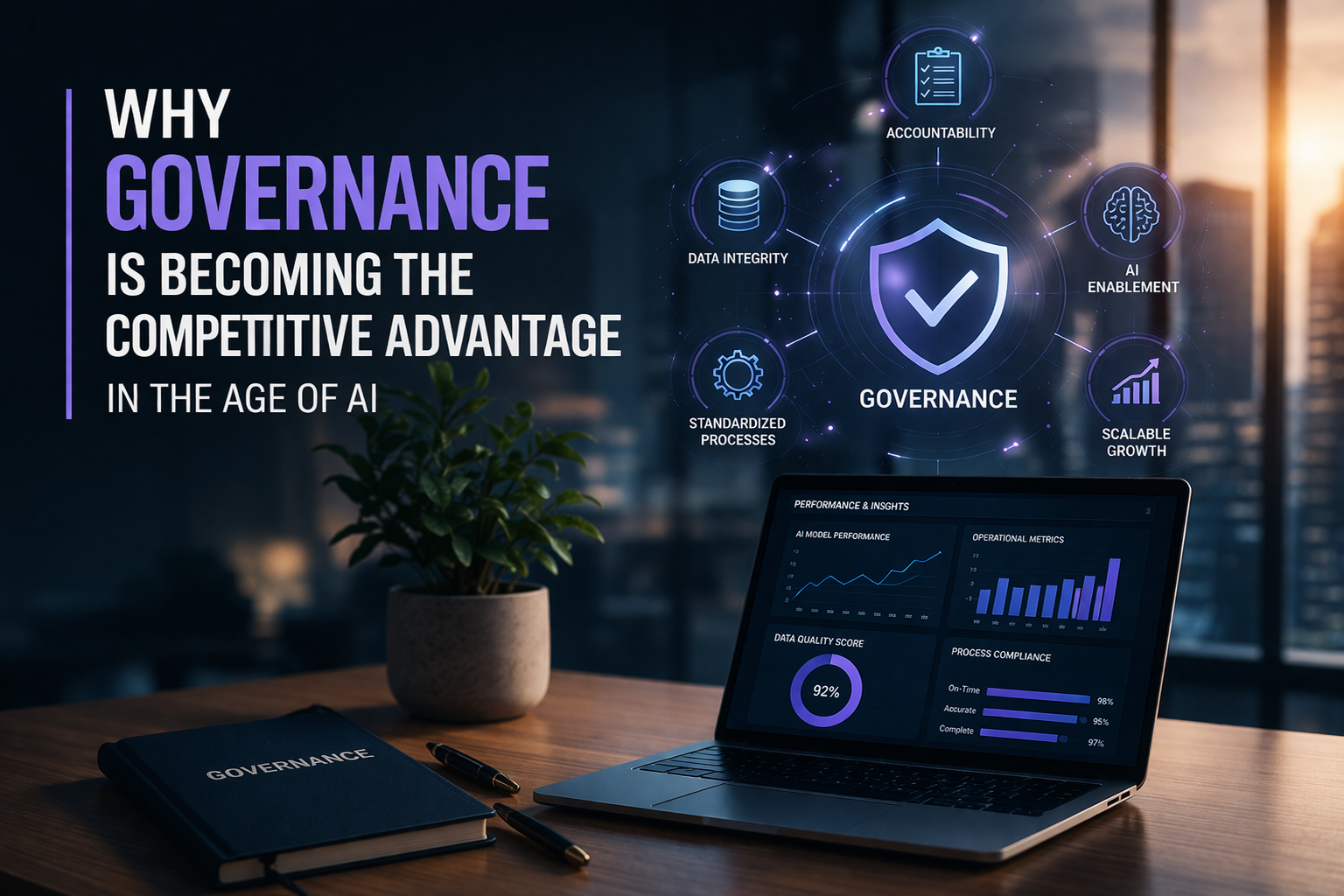
For years, governance has had a branding problem.
It has been associated with bureaucracy, compliance, and friction. Something necessary—but rarely valuable. Most organizations treated governance as a back-office function designed to slow things down just enough to stay out of trouble.
That perception is no longer just outdated—it’s dangerous.
In 2026, governance is no longer a constraint.
It is becoming one of the most powerful competitive advantages a company can build.
As organizations race to adopt AI, automate workflows, and scale operations, one reality is becoming clear:
The companies that succeed are not the ones moving the fastest.
They are the ones that can scale with control.
And that is exactly what governance enables.
The Shift: From Risk Management to Performance Enablement
Traditionally, governance existed to manage risk.
It showed up as:
- Compliance checklists
- Approval workflows
- Data access restrictions
- Audit processes
Its purpose was clear: prevent things from going wrong.
But in today’s environment, that definition is incomplete.
Modern organizations are no longer struggling to start initiatives.
They are struggling to scale them effectively.
AI pilots are everywhere.
Dashboards are abundant.
Automation tools are widely deployed.
Yet despite all this activity, many companies find themselves stuck:
- AI initiatives fail to deliver ROI
- Data remains fragmented and unreliable
- Operations become more complex, not less
The issue is not effort.
It is not even technology.
It is the absence of a system that connects everything together.
Governance, when done correctly, is that system.
It shifts from being a control mechanism to becoming a performance infrastructure—the layer that allows organizations to scale without breaking.
Why Governance Matters More Than Ever
1. AI Has Increased the Cost—and Speed—of Mistakes
In traditional systems, errors were often contained.
A reporting mistake might affect a single decision.
A process breakdown might impact a single team.
AI changes that dynamic entirely.
AI systems operate at:
- High speed
- High volume
- High impact
A single flaw in logic, data, or configuration can be replicated across thousands of decisions in seconds.
Without governance:
- Errors scale instantly
- Decisions become inconsistent
- Trust erodes quickly
The risk is no longer just making a mistake.
The risk is making the same mistake everywhere, all at once.
Governance introduces:
- Validation mechanisms
- Monitoring systems
- Defined escalation paths
It ensures that speed does not come at the expense of control.
2. Data Complexity Is Growing Faster Than Most Organizations Can Handle
Most businesses today operate across a fragmented ecosystem:
- Multiple SaaS platforms
- Legacy systems
- Manual processes
- Disconnected datasets
The result is a familiar set of problems:
- Conflicting reports across departments
- Lack of confidence in metrics
- Delayed or poor decision-making
When data is inconsistent, decisions become subjective.
And when decisions are subjective, scale becomes impossible.
Governance brings structure to this chaos.
It establishes:
- Standard definitions
- Clear data ownership
- Consistent data flows
Instead of asking, “Which number is correct?”
Organizations can focus on, “What should we do next?”
3. Speed Without Structure Creates Friction
There is a persistent myth that governance slows organizations down.
In reality, the absence of governance is what creates friction.
Without structure:
- Teams duplicate work
- Processes vary by department
- Decisions require constant clarification
- Errors lead to rework
This creates hidden inefficiencies that compound over time.
With governance:
- Roles and responsibilities are clear
- Processes are standardized
- Decisions follow defined frameworks
- Systems operate predictably
The result is not slower execution—it is faster, more consistent execution.
Structure does not restrict movement.
It removes unnecessary resistance.
Governance as a Growth Lever
The highest-performing organizations are no longer asking:
“How do we reduce risk?”
They are asking:
“How do we scale intelligently?”
This shift is critical.
Governance is no longer just a defensive strategy.
It is a growth enabler.
When governance is embedded into operations:
- AI can be deployed with confidence
- Automation can scale without breaking workflows
- Data can be trusted across the organization
It becomes the foundation that allows innovation to move from isolated experiments to enterprise-wide impact.
What Strong Governance Actually Looks Like
Governance is often misunderstood as documentation, policies, or oversight committees.
In practice, effective governance is operational.
It is built into how work gets done—not layered on top of it.
Here are the core components of modern governance:
1. Clear Ownership
Every system, dataset, and process must have a defined owner.
This includes:
- Who is responsible for accuracy
- Who is accountable for outcomes
- Who has authority to make changes
Without ownership, accountability disappears.
AI initiatives fail.
Data quality degrades.
Decisions stall.
Ownership creates clarity.
And clarity enables action.
2. Standardized, Repeatable Processes
Organizations that scale successfully do not rely on ad hoc execution.
They build processes that are:
- Defined
- Repeatable
- Measurable
This reduces variability and increases efficiency.
It also enables:
- Easier onboarding
- Better performance tracking
- Continuous improvement
Standardization is not about rigidity.
It is about reliability.
3. Data Integrity and Trust
Data governance is a critical component of overall governance.
Organizations must be able to answer:
- Where does this data come from?
- How is it transformed?
- Can it be trusted?
Without this, analytics becomes noise.
Strong governance ensures:
- Consistent definitions across teams
- Reliable data pipelines
- Visibility into data lineage
When data is trusted, decisions accelerate.
4. Embedded Accountability
Governance cannot exist as a separate function.
It must be embedded into:
- Systems
- Workflows
- Decision-making processes
This means:
- Governance rules are enforced automatically where possible
- Accountability is tied to outcomes
- Processes are designed with governance in mind
When governance is embedded, it becomes invisible—but powerful.
Why Most Organizations Are Still Behind
Despite its importance, most organizations are underinvesting in governance.
They focus heavily on:
- Tools
- Dashboards
- AI models
- Automation platforms
These investments are important—but incomplete.
Tools do not create alignment.
Technology does not create structure.
Without governance:
- AI remains experimental
- Data remains fragmented
- Operations remain inconsistent
This creates a widening gap between organizations that can scale and those that cannot.
The Emerging Divide: Governed vs. Ungoverned Organizations
We are beginning to see a clear separation in the market.
Ungoverned Organizations:
- Struggle to scale AI beyond pilots
- Experience inconsistent results across teams
- Rely on manual workarounds
- Operate reactively
Governed Organizations:
- Scale AI across core workflows
- Maintain consistency across operations
- Make faster, data-driven decisions
- Operate proactively
The difference is not intelligence.
It is not talent.
It is not even budget.
It is structure.
Governance in the Age of AI: A New Imperative
AI is accelerating the need for governance.
As systems become more autonomous, organizations must answer new questions:
- How do we monitor AI decisions in real time?
- How do we ensure outputs align with business goals?
- How do we manage risk at scale?
This introduces new requirements:
- Real-time monitoring systems
- Automated controls and safeguards
- Clear escalation pathways
The traditional “human-in-the-loop” model is evolving into a “human-on-the-loop” model, where humans oversee systems rather than directly controlling every action.
This shift makes governance even more critical.
At machine speed, manual oversight is not enough.
Control must be built into the system itself.
The Bottom Line
Governance is no longer optional.
It is not just about compliance.
It is not just about control.
It is about performance, scalability, and competitive advantage.
In an environment defined by:
- AI adoption
- Data complexity
- Rapid operational scaling
The organizations that win will not be the ones with the most tools.
They will be the ones with:
- The clearest systems
- The strongest governance
- The ability to operationalize strategy at scale
Final Thought
If your organization is investing in AI, automation, or data—but not governance—you are building on an unstable foundation.
And unstable systems do not scale.
Governance is not what slows organizations down.
It is what allows them to move faster—with confidence.