
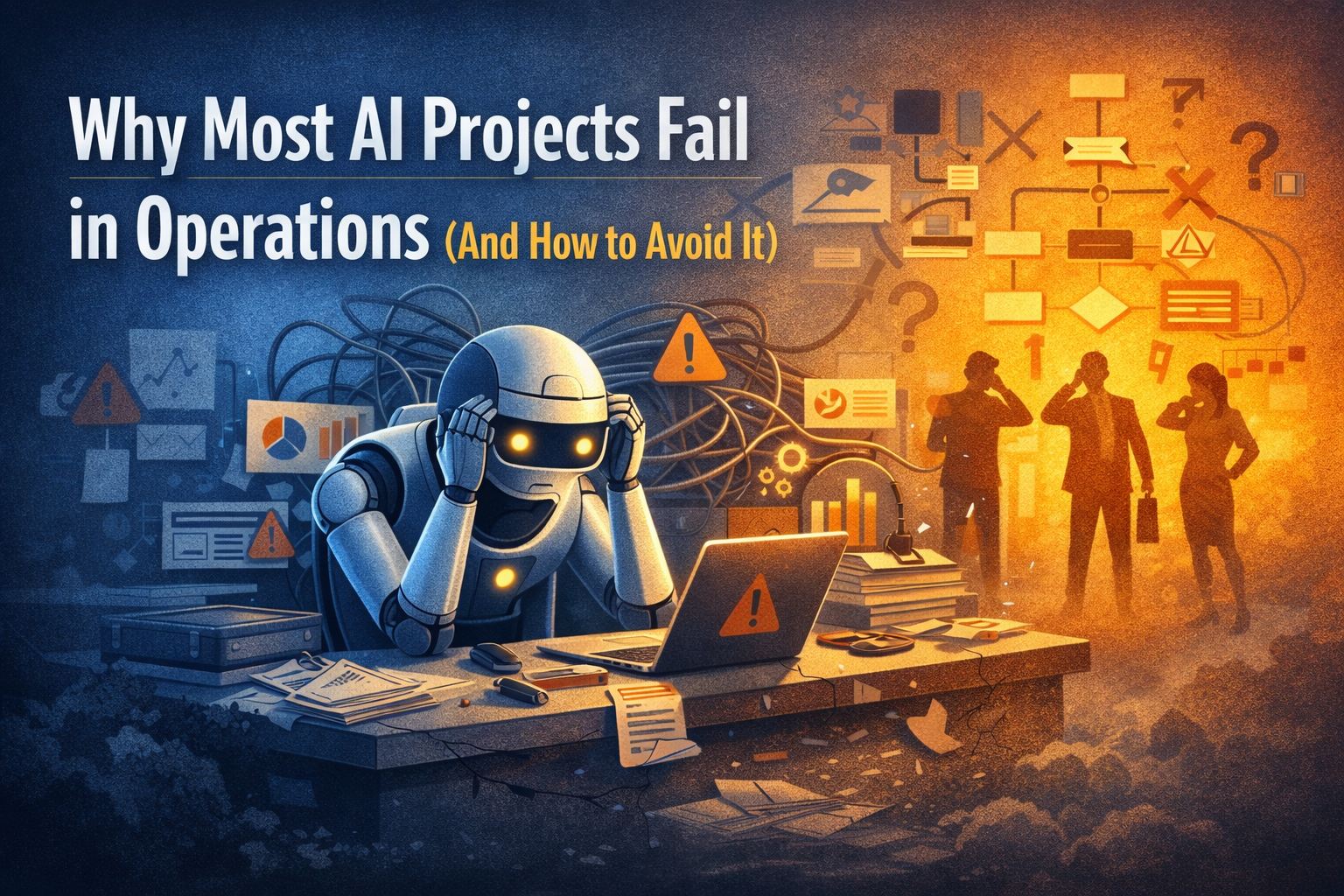
Why Most AI Projects Fail in Operations (And How to Avoid It)

Artificial intelligence is dominating boardroom conversations.
Executives are being told that AI will reduce costs, automate work, increase productivity, and unlock entirely new business models. The pressure to “implement AI” is intense, and many organizations are racing to deploy tools across operations, customer service, analytics, and internal workflows.
Yet despite the excitement, a growing number of AI initiatives quietly stall or fail.
Projects launch with enthusiasm but fail to deliver meaningful results. Automation tools are implemented but underused. AI systems generate insights that teams don’t trust. Dashboards become more complex but not more actionable.
The issue is rarely the technology itself.
More often, the problem is operational readiness.
Successful AI adoption requires far more than deploying a tool or integrating an API. It requires clear processes, reliable data, defined metrics, and disciplined operational systems.
Without those foundations, AI does not solve inefficiencies—it amplifies them.
Understanding why AI projects fail in operations is the first step toward implementing them successfully.
The Gap Between AI Expectations and Operational Reality
Much of the excitement around artificial intelligence focuses on what the technology can do: automate tasks, analyze massive datasets, generate predictions, and accelerate decision-making.
But in practice, AI systems operate within existing operational environments.
If the underlying systems are fragmented, inconsistent, or poorly documented, AI models struggle to produce reliable outputs.
Consider a few common scenarios:
- Sales data exists in multiple systems with different definitions of revenue.
- Customer onboarding processes vary depending on which team handles the account.
- Reporting metrics are manually assembled from spreadsheets every month.
- Departments track their own data with different naming conventions and structures.
In environments like this, AI tools cannot operate effectively. Instead of improving efficiency, they inherit the same inconsistencies that already exist across the organization.
AI does not replace operational discipline. It depends on it.
Why AI Projects Often Fail
There are several recurring reasons AI initiatives fail to deliver value in operational environments.
Poor Data Foundations
AI systems rely on structured, consistent, and trustworthy data.
Many organizations discover during implementation that their data environment is far less organized than expected. Customer records may exist in multiple formats across systems. Key metrics may be calculated differently by different teams. Historical data may contain gaps or inconsistencies.
When data quality is poor, AI outputs become unreliable.
Teams quickly lose confidence in the system, and adoption declines.
Before AI can be effective, organizations must establish strong data governance and reliable pipelines.
Undefined Operational Processes
AI systems perform best when they are embedded within clearly defined workflows.
However, many operational processes are not fully documented. Work is often handled through informal coordination—Slack messages, email threads, or individual team members’ personal systems.
Without standardized processes, it becomes difficult to identify where AI should be applied or how its outputs should influence decisions.
In these situations, AI tools generate insights, but no one is responsible for acting on them.
The result is interesting analysis with little operational impact.
Tool-First Thinking
Many organizations approach AI by selecting tools first and defining strategy later.
A new AI platform is purchased, integrated into existing systems, and expected to produce immediate improvements.
But technology alone rarely solves operational problems.
Without clear objectives—such as reducing reporting time, improving forecasting accuracy, or automating specific workflows—AI deployments can become expensive experiments rather than strategic initiatives.
Effective AI adoption begins with operational goals, not software selection.
Lack of Change Management
Operational systems involve people as much as technology.
Even when AI tools function correctly, they may fail if teams do not trust or understand them.
For example, a forecasting model may produce accurate predictions, but if sales teams continue relying on their own spreadsheets, the model will be ignored.
Similarly, automated workflows may exist but remain unused because employees are unsure when or how to rely on them.
AI initiatives require communication, training, and clear ownership to succeed.
Without organizational adoption, the technology itself becomes irrelevant.
Misaligned Metrics
Another common failure point is unclear success criteria.
Organizations may deploy AI tools without defining how success will be measured.
Are the goals to reduce manual labor? Improve forecast accuracy? Increase customer retention? Accelerate decision-making?
If success metrics are not defined upfront, it becomes difficult to evaluate whether the AI initiative is delivering value.
Operational leaders need clear KPIs tied to business outcomes—not just technical performance.
AI Is a Multiplier, Not a Replacement
A useful way to think about artificial intelligence is as a multiplier.
It multiplies the strength—or weakness—of existing systems.
If processes are structured, data is clean, and decision-making frameworks are clear, AI can dramatically increase efficiency.
If systems are fragmented and processes are inconsistent, AI simply magnifies those problems.
This is why many organizations experience frustration after early AI experiments. They expect the technology to fix operational chaos when in reality it exposes it.
Successful AI adoption begins with operational clarity.
Building the Foundation for Successful AI Implementation
Organizations that successfully integrate AI into operations typically follow a structured approach.
Rather than rushing directly into technology adoption, they focus first on strengthening their operational systems.
Establish Reliable Data Infrastructure
AI systems require consistent, centralized data.
This often involves building or refining data pipelines, integrating key systems, and establishing clear definitions for core metrics.
Important steps include:
- Creating a single source of truth for operational metrics
- Standardizing naming conventions and reporting definitions
- Integrating data across key platforms such as CRM, finance, and product systems
- Implementing reliable data validation processes
Once data is structured and trustworthy, AI models can operate effectively.
Document and Standardize Core Processes
Before applying AI to a workflow, the workflow itself must be clearly defined.
Organizations should map key operational processes, including:
- Lead generation and sales pipeline management
- Customer onboarding and support processes
- Financial reporting and forecasting
- Product delivery workflows
By documenting these processes, organizations can identify where automation or AI augmentation will create the greatest value.
AI works best when embedded within well-designed operational systems.
Identify High-Impact Use Cases
Not every process requires AI.
Successful organizations focus on specific operational challenges where AI can deliver measurable improvements.
Examples include:
- Forecasting revenue or demand
- Automating repetitive reporting tasks
- Detecting anomalies in operational metrics
- Predicting customer churn or support issues
- Automating internal knowledge retrieval
By targeting high-impact use cases, organizations can demonstrate early value and build internal confidence in AI systems.
Align AI Projects With Business Outcomes
Every AI initiative should connect directly to business objectives.
Examples of clear outcome-based goals include:
- Reducing reporting preparation time by 80 percent
- Improving demand forecasting accuracy by 20 percent
- Reducing manual reconciliation work across departments
- Increasing operational visibility for leadership teams
When AI projects are tied to measurable results, organizations can evaluate success and continuously improve their systems.
Invest in Adoption and Training
Technology alone does not transform operations.
Teams must understand how to incorporate AI tools into their daily workflows.
This requires clear communication about:
- How AI outputs should be interpreted
- When employees should rely on automated insights
- What responsibilities remain human-driven
Organizations that prioritize adoption alongside implementation achieve far higher success rates with AI initiatives.
The Operational Advantage
Companies that approach AI implementation with strong operational discipline gain a significant advantage.
They move faster from experimentation to real-world impact.
Instead of chasing trends, they build systems that support continuous improvement.
Their operations teams spend less time assembling data and more time interpreting insights. Leadership gains confidence in reporting and forecasting. Employees can focus on higher-value work rather than manual coordination.
In these environments, AI becomes an operational accelerator rather than an isolated experiment.
Final Thoughts
Artificial intelligence has enormous potential to transform business operations.
But technology alone does not create operational excellence.
Organizations that succeed with AI do not begin with algorithms—they begin with systems.
They build clean data infrastructure, structured workflows, consistent metrics, and clear accountability. Only then do they introduce AI as a layer of intelligence on top of those foundations.
In other words, they treat AI as part of operational design rather than a shortcut around it.
For companies willing to invest in that foundation, AI becomes far more than a buzzword.
It becomes a genuine competitive advantage.