
Why Your Business Still Runs on Spreadsheets (And Why That’s a Bigger Problem Than You Think)

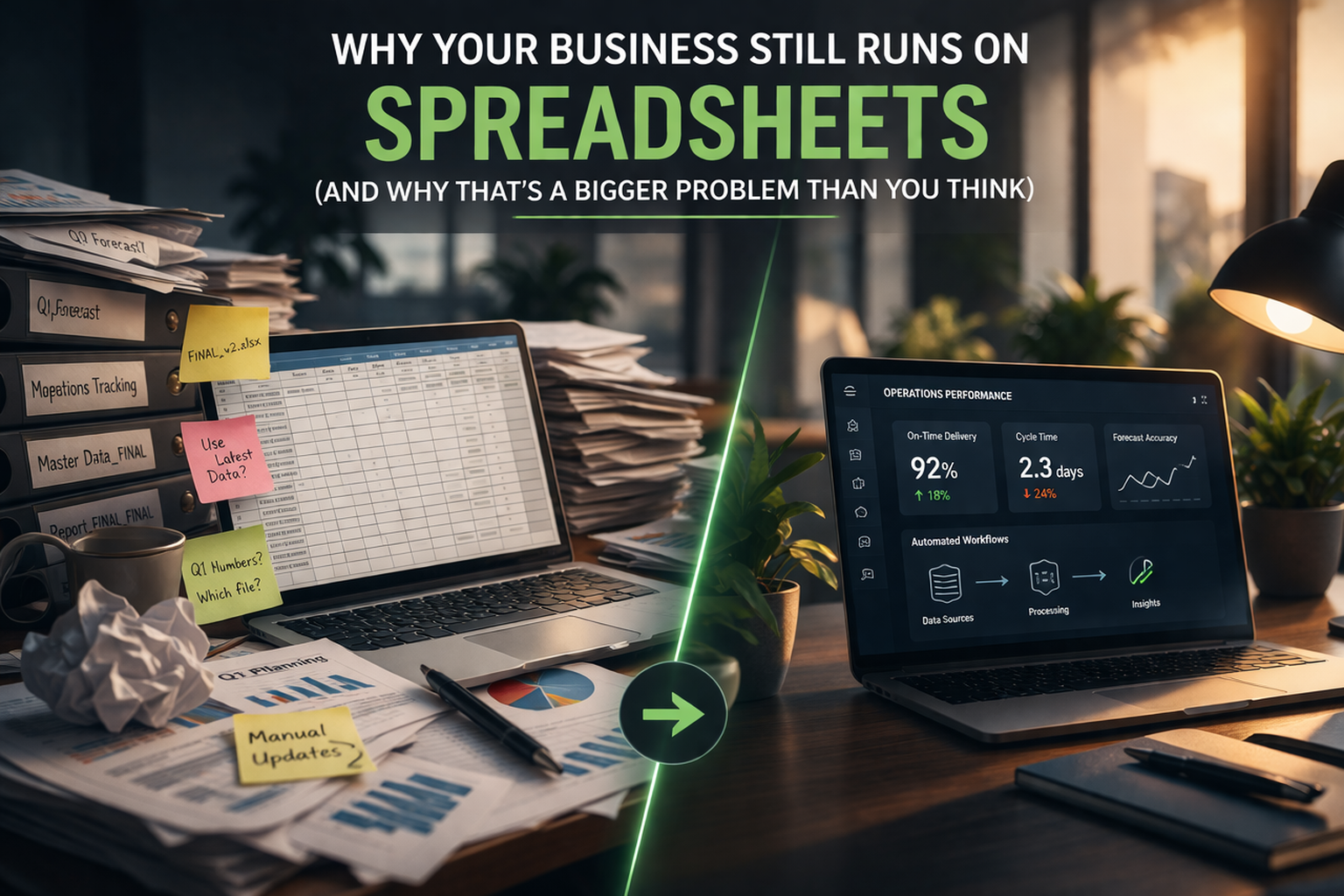
Spreadsheets are still the backbone of modern business.
Finance teams rely on them for forecasting.
Operations teams use them to track performance.
Leadership teams depend on them for reporting and decision-making.
Even companies that have invested heavily in data platforms, automation tools, and AI still find themselves going back to spreadsheets.
At first glance, this doesn’t seem like a problem.
Spreadsheets are flexible.
They’re familiar.
They’re powerful.
But beneath the surface, they create one of the most significant—and least visible—risks to growing companies:
Operational fragility.
The Spreadsheet Paradox
Spreadsheets are one of the most successful tools ever created.
They enable anyone in an organization to:
- Build models
- Analyze data
- Track performance
- Create reports
All without needing engineering support.
That accessibility is exactly why they’ve become so dominant.
But it’s also why they become dangerous at scale.
Because spreadsheets are so easy to create, they often evolve without:
- Structure
- Standardization
- Governance
- Long-term design
What starts as a quick solution becomes a critical system.
And over time, businesses unknowingly build entire operations on top of files that were never meant to support them.
How Spreadsheets Quietly Become Infrastructure
No company sets out to “run on spreadsheets.”
It happens gradually.
A team creates a spreadsheet to solve a problem:
- A tracker for operations
- A report for leadership
- A model for forecasting
Then someone improves it.
Another team copies it.
A new version is created.
More logic is added.
More dependencies form.
Eventually, that spreadsheet becomes:
- The source of truth
- The workflow
- The reporting layer
- The decision engine
But no one ever steps back and says:
“This is now a system. Should we design it properly?”
Instead, it continues to grow organically.
And that’s where the risk begins.
The Hidden Costs of Spreadsheet-Driven Operations
Spreadsheets don’t break in obvious ways.
They don’t crash your system.
They don’t send alerts.
They don’t fail loudly.
They fail quietly—through inefficiency, inconsistency, and risk.
1. You Don’t Have One Version of the Truth
Different teams maintain different spreadsheets.
Each one has:
- Slightly different logic
- Different assumptions
- Different update cycles
When leadership asks a simple question—“What are our numbers?”—the answer isn’t straightforward.
Instead, teams spend time:
- Reconciling data
- Explaining discrepancies
- Debating which version is correct
This isn’t just inefficient—it slows down decision-making at the highest level.
2. Your Team Is Doing Work That Shouldn’t Exist
In spreadsheet-driven environments, a significant portion of time is spent on:
- Data preparation
- Manual updates
- Cleaning and formatting
- Cross-checking numbers
This work doesn’t create value.
It’s maintenance.
As your company grows, this burden grows with it.
Instead of scaling efficiently, you scale complexity and manual effort.
3. Your Operations Depend on Specific People
Every organization has “that spreadsheet.”
The one:
- Only one person fully understands
- That no one wants to touch
- That everything depends on
This creates key-person risk.
If that person leaves, or is unavailable, critical processes can stall or break entirely.
Your operations should not depend on individual knowledge—they should be embedded in systems.
4. Errors Are Inevitable—and Hard to Detect
Spreadsheets are highly error-prone.
A single:
- Broken formula
- Incorrect reference
- Copy-paste mistake
Can cascade into major issues:
- Incorrect forecasts
- Misaligned planning
- Faulty financial reporting
And because spreadsheets lack robust validation, these errors often go unnoticed until the consequences are significant.
5. Decision-Making Slows Down
In fast-moving businesses, speed matters.
But spreadsheet-based workflows introduce friction:
- Data needs to be gathered
- Reports need to be updated
- Numbers need to be validated
By the time leadership receives information, it’s often already outdated.
Instead of enabling faster decisions, spreadsheets delay them.
Why This Becomes Critical as You Scale
Spreadsheets work well in early-stage environments.
When:
- Teams are small
- Data is limited
- Processes are simple
They are often the best tool available.
But as your business grows, three things change:
1. Complexity Increases
You now have:
- Multiple systems
- Multiple teams
- Interconnected processes
Spreadsheets don’t handle complexity well.
They weren’t designed for it.
2. The Cost of Mistakes Increases
At scale, small errors become expensive.
A minor forecasting error can impact:
- Inventory levels
- Cash flow
- Customer satisfaction
The margin for error shrinks as the business grows.
3. Speed Becomes a Competitive Advantage
Companies that can:
- Access accurate data quickly
- Make decisions faster
- Execute with clarity
Outperform those that can’t.
Spreadsheet-driven workflows are fundamentally slower.
The AI Illusion
Many companies believe the solution to their challenges is AI.
And while AI is powerful, it doesn’t fix broken foundations.
In fact, it often exposes them.
AI systems require:
- Clean, structured data
- Consistent definitions
- Reliable processes
Spreadsheets typically provide:
- Fragmented data
- Inconsistent logic
- Poor documentation
So instead of unlocking value, AI initiatives stall.
Or worse—they produce unreliable outputs.
AI built on top of spreadsheet-driven operations doesn’t create leverage—it amplifies chaos.
The Illusion of Control
One of the reasons spreadsheets persist is psychological.
They give teams a sense of control.
You can:
- See everything
- Edit anything
- Customize everything
But this flexibility comes at a cost.
There is:
- No enforced structure
- No standardized logic
- No system-level integrity
What feels like control is often just controlled chaos.
What High-Performing Companies Do Differently
Companies that scale successfully don’t eliminate spreadsheets overnight.
They evolve beyond them.
They shift from files to systems.
1. They Build a Single Source of Truth
Data is:
- Centralized
- Consistent
- Accessible
Everyone works from the same foundation.
2. They Design Operational Systems (Not Just Reports)
Instead of asking:
“Where do we track this?”
They ask:
“How should this process work?”
They define:
- Inputs
- Outputs
- Ownership
- Flow of information
3. They Automate the Right Things
Not everything needs automation.
But repetitive, manual processes do.
They remove:
- Data copying
- Manual updates
- Reconciliation work
And replace it with automated pipelines.
4. They Embed Decisions into Workflows
Instead of static reports, they create systems that:
- Surface insights in real time
- Support decisions at the point of action
- Reduce reliance on interpretation
5. They Reduce Dependency on Individuals
Knowledge is captured in systems.
Processes are:
- Documented
- Repeatable
- Scalable
The business no longer relies on “who knows what.”
A Practical Example
Consider a company managing demand forecasting.
Spreadsheet-driven approach:
- Data is exported from multiple systems
- Analysts manually combine and clean it
- Forecasts are built in Excel
- Results are shared via email
Challenges:
- Time-consuming
- Error-prone
- Hard to scale
System-driven approach:
- Data is automatically integrated
- Forecasting models run continuously
- Outputs feed directly into planning workflows
- Teams access real-time insights
Result:
- Faster decisions
- Better accuracy
- Reduced operational burden
The difference isn’t just efficiency.
It’s capability.
When Should You Rethink Your Reliance on Spreadsheets?
You don’t need to eliminate spreadsheets entirely.
But you should start questioning them when:
- Your team spends more time preparing data than using it
- You have conflicting numbers across reports
- Key processes depend on one person’s file
- Decisions are consistently delayed
- Errors are becoming costly
These are not small inefficiencies.
They are signals your operations are not built to scale.
The Shift: From Tools to Infrastructure
The real shift is not about replacing spreadsheets.
It’s about changing how you think about operations.
Spreadsheets are tools.
But your business needs infrastructure.
Infrastructure is:
- Reliable
- Scalable
- Structured
- Designed
It doesn’t break when complexity increases.
It doesn’t depend on individuals.
It supports growth instead of limiting it.
Final Thought
Spreadsheets are not the enemy.
They are one of the most useful tools ever created.
But they were never meant to run a business.
If your operations still depend on spreadsheets, the issue isn’t the tool.
It’s what’s missing around it.
Because in today’s environment:
- Complexity is increasing
- Speed matters more than ever
- AI is raising the bar for execution
And businesses built on fragile foundations will struggle to keep up.
The companies that win won’t be the ones with the most tools.
They’ll be the ones with the best systems.