
Begin with the End in Mind: The Leadership Habit That Separates Successful Transformations from Expensive Experiments

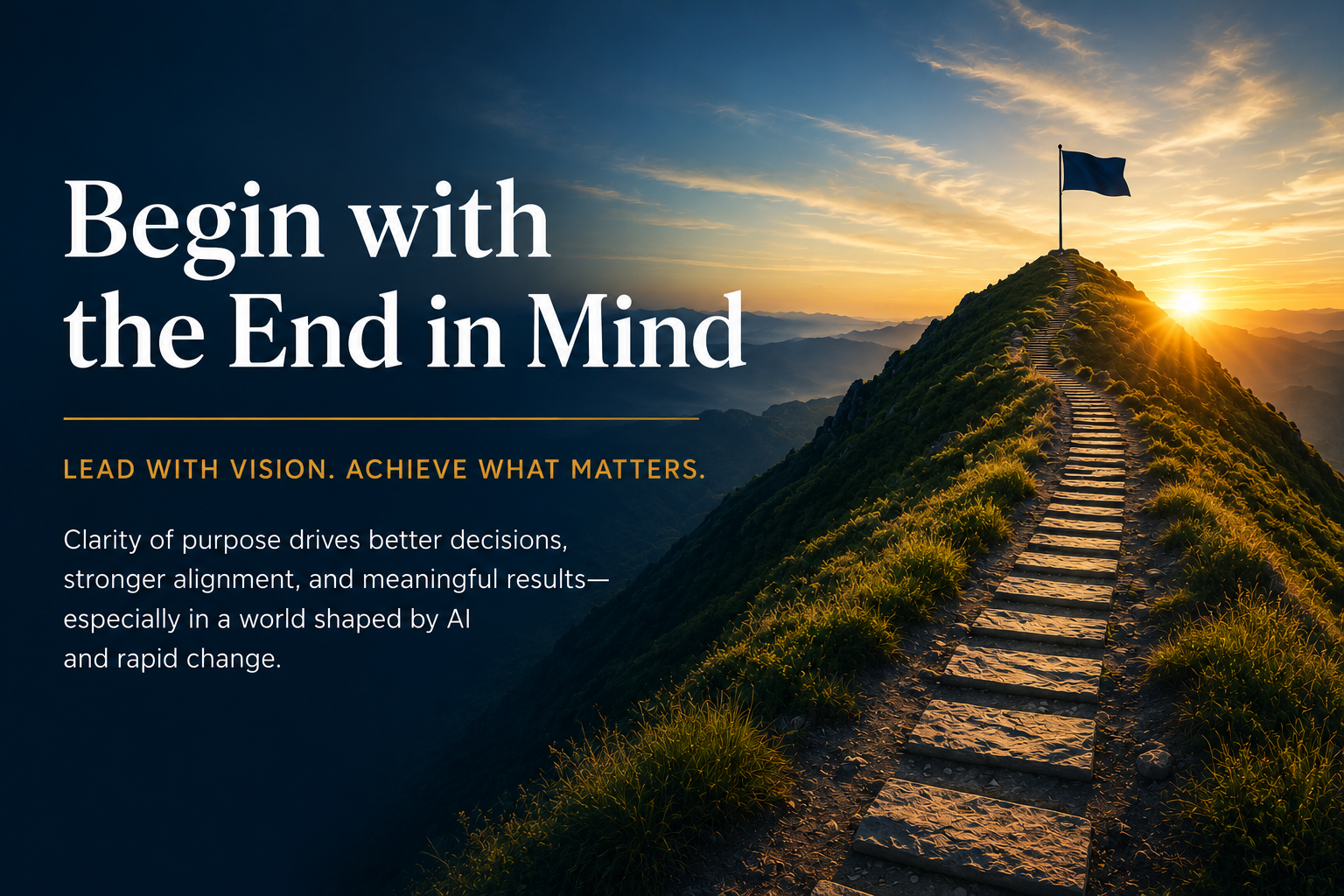
Habit 2 of Stephen Covey's 7 Habits of Highly Effective People
Organizations have never had more opportunities to innovate than they do today.
Artificial intelligence is reshaping how work gets done. Data is more accessible than ever before. New technologies promise increased efficiency, better customer experiences, and smarter decision-making. Leaders are under constant pressure to modernize, transform, and remain competitive in an environment that seems to evolve by the week.
Yet despite unprecedented access to technology and information, many organizations continue to struggle with transformation efforts. Projects run over budget. Technology implementations fail to deliver expected value. Strategic initiatives lose momentum. Employees become overwhelmed by change fatigue. Leaders find themselves questioning why so much effort produced so little impact.
The answer often has less to do with execution and more to do with direction.
Stephen Covey's second habit, Begin with the End in Mind, offers a timeless leadership principle that may be more relevant today than when it was first published. While technology, markets, and business models have changed dramatically over the past several decades, the underlying challenge remains the same: organizations frequently become so focused on what they are doing that they lose sight of why they are doing it.
The most successful leaders understand that meaningful transformation does not begin with technology, budgets, or project plans. It begins with clarity.
Before launching a new initiative, implementing a new system, or investing in artificial intelligence, leaders must first define what success looks like. They must establish a vision of the future state they are trying to create and ensure that every decision supports that destination.
In a world increasingly defined by disruption and complexity, the ability to begin with the end in mind has become one of the most important leadership capabilities an organization can develop.
Why Organizations Struggle With Transformation
One of the most common patterns we observe in organizations is the tendency to confuse activity with progress.
A leadership team announces a digital transformation initiative.
New software is purchased.
Consultants are hired.
Project teams are formed.
Meetings are scheduled.
Reports are generated.
Months later, the organization has invested substantial time, energy, and resources, yet leaders struggle to identify meaningful business outcomes.
The initiative may be technically successful while simultaneously failing to achieve its intended purpose.
This occurs because organizations often focus on the solution before clearly defining the problem.
They ask:
- What technology should we implement?
- What software should we buy?
- Which AI platform should we use?
- What process should we automate?
These are important questions, but they are not the first questions leaders should ask.
A more effective approach begins with a different set of questions:
- What challenge are we trying to solve?
- What outcome are we trying to achieve?
- How will our organization be different if we succeed?
- How will we measure progress?
- What value will this create for employees, customers, and stakeholders?
These questions force leaders to move beyond tactical decisions and focus on strategic outcomes.
The distinction may seem subtle, but it fundamentally changes how organizations approach transformation.
The AI Gold Rush and the Importance of Strategic Intent
Few areas illustrate this challenge better than artificial intelligence.
Over the past several years, organizations across every industry have rushed to explore AI applications. Executives are understandably concerned about falling behind competitors. Boards are asking questions. Employees are experimenting with new tools. Vendors are promoting solutions that promise to revolutionize nearly every aspect of business operations.
The excitement is real, and the opportunities are significant.
However, many organizations are approaching AI from the wrong direction.
They begin by asking:
"How can we use AI?"
The better question is:
"What business outcome are we trying to achieve, and how might AI help us achieve it?"
The difference is profound.
Organizations that begin with technology often find themselves chasing capabilities without creating value. They implement tools because they are innovative rather than because they are necessary. They launch pilot programs without defining success metrics. They invest in solutions before understanding the operational problems those solutions are intended to address.
As a result, they generate activity rather than impact.
Organizations that begin with the end in mind take a different approach.
They identify specific goals such as:
- Reducing manual administrative work
- Improving customer response times
- Enhancing employee productivity
- Accelerating decision-making
- Improving service delivery
- Increasing operational efficiency
Only after those goals are clearly defined do they evaluate how AI can support them.
Technology becomes a means to an end rather than the end itself.
This distinction is what separates successful transformation from expensive experimentation.
Leadership's Responsibility to Create Clarity
One of the greatest misconceptions in organizational change is the belief that clarity will emerge naturally as projects progress.
In reality, clarity is a leadership responsibility.
Employees should not have to guess what success looks like.
Project teams should not be forced to interpret strategic priorities.
Departments should not be competing for resources based on conflicting visions of the future.
Leaders must create and communicate a compelling picture of where the organization is headed.
This is particularly important during periods of significant change.
When uncertainty increases, people naturally seek direction. They want to understand why changes are occurring, how those changes align with broader organizational goals, and what role they play in achieving success.
Without that clarity, even talented teams can become fragmented.
Departments begin optimizing for their own objectives rather than organizational outcomes. Resources become scattered across competing priorities. Decision-making slows because stakeholders lack a common framework for evaluating opportunities.
A clearly defined vision serves as an anchor.
It provides a consistent point of reference for every decision, investment, and initiative.
When leaders articulate a compelling future state, alignment becomes easier because everyone understands the destination.
Organizational Alignment Is a Competitive Advantage
Many organizations underestimate the power of alignment.
In reality, alignment may be one of the most significant competitive advantages available to modern organizations.
Consider what happens when departments operate independently.
Operations focuses on efficiency.
Technology focuses on implementation.
Human Resources focuses on workforce development.
Finance focuses on cost management.
Each function may be performing well individually, yet the organization as a whole struggles to achieve strategic objectives.
The issue is not competence.
The issue is coordination.
Organizations that begin with the end in mind establish a shared vision that transcends departmental boundaries.
Everyone understands:
- What the organization is trying to accomplish
- Why those objectives matter
- How success will be measured
- How their work contributes to broader outcomes
This creates a level of organizational coherence that accelerates execution and improves decision-making.
Alignment reduces friction.
It reduces duplication of effort.
It improves accountability.
Most importantly, it ensures that resources are directed toward initiatives that create meaningful value.
The Connection Between Habit 2 and Change Management
One reason transformation efforts fail is that organizations focus heavily on implementation while neglecting adoption.
Leaders spend months selecting technology, designing processes, and developing project plans.
Far less time is spent helping people understand why the change matters.
Employees are far more likely to embrace change when they can clearly see the destination.
People do not resist change as much as they resist uncertainty.
When leaders articulate a compelling future state, they create a sense of purpose that helps employees navigate disruption.
Instead of experiencing change as something imposed upon them, employees begin to see themselves as participants in a meaningful journey.
This shift can dramatically improve engagement, adoption, and long-term success.
Beginning with the end in mind is therefore not only a strategic planning principle. It is also a powerful change management tool.
Measuring What Matters
Another critical aspect of Habit 2 is measurement.
Organizations often track activities because they are easy to measure.
Examples include:
- Number of training sessions delivered
- Number of software licenses deployed
- Number of AI pilots launched
- Number of meetings conducted
While these metrics provide useful information, they do not necessarily indicate success.
Effective leaders focus on outcomes.
Instead of asking how many initiatives were launched, they ask:
- Did customer satisfaction improve?
- Did cycle times decrease?
- Did employee productivity increase?
- Did service delivery improve?
- Did operational costs decline?
- Did decision-making become more effective?
These are the metrics that matter.
When organizations begin with the end in mind, measurement becomes significantly more meaningful because success has already been defined.
Every metric serves a purpose.
Every KPI supports a strategic objective.
Every dashboard tells a story about progress toward a desired future state.
Building Future-Ready Organizations
The organizations that will thrive over the next decade will not necessarily be the ones that adopt the most technology.
They will be the ones that apply technology with the greatest intentionality.
They will be organizations that understand their mission, define clear objectives, and align resources around meaningful outcomes.
They will invest in people as aggressively as they invest in technology.
They will view AI as a strategic enabler rather than a standalone initiative.
They will make decisions based on long-term value creation rather than short-term activity.
Most importantly, they will consistently begin with the end in mind.
A Practical Leadership Framework
Before launching any major initiative, consider five simple questions:
- What problem are we trying to solve?
- What does success look like?
- How will we measure progress?
- Why does this matter to the organization?
- How will this initiative support our long-term vision?
If leaders cannot answer these questions clearly, the initiative may not be ready to move forward.
Clarity before action is almost always less expensive than correction after implementation.
Final Thoughts
In today's environment, leaders face constant pressure to move faster, innovate more aggressively, and adapt to emerging technologies. While speed has value, direction matters even more.
The organizations that achieve lasting success are not those that pursue every opportunity. They are the organizations that pursue the right opportunities with discipline and purpose.
Stephen Covey's Habit 2 reminds us that effective leadership begins with vision. It challenges us to define success before pursuing it and to align every decision with the future we hope to create.
Whether your organization is implementing artificial intelligence, modernizing operations, developing future leaders, or embarking on a large-scale transformation, the principle remains unchanged.
Begin with the end in mind.
Because when leaders are clear about where they are going, every investment, every initiative, and every decision becomes more intentional, more aligned, and ultimately more impactful.
At Kimemasu, we believe the most successful transformations start long before technology is selected or projects are launched. They start with clarity, purpose, and a shared vision of success. Organizations that embrace this mindset are not simply preparing for the future—they are actively creating it.