
Project Management with AI: How Artificial Intelligence Is Reshaping the Way Successful Teams Deliver Projects

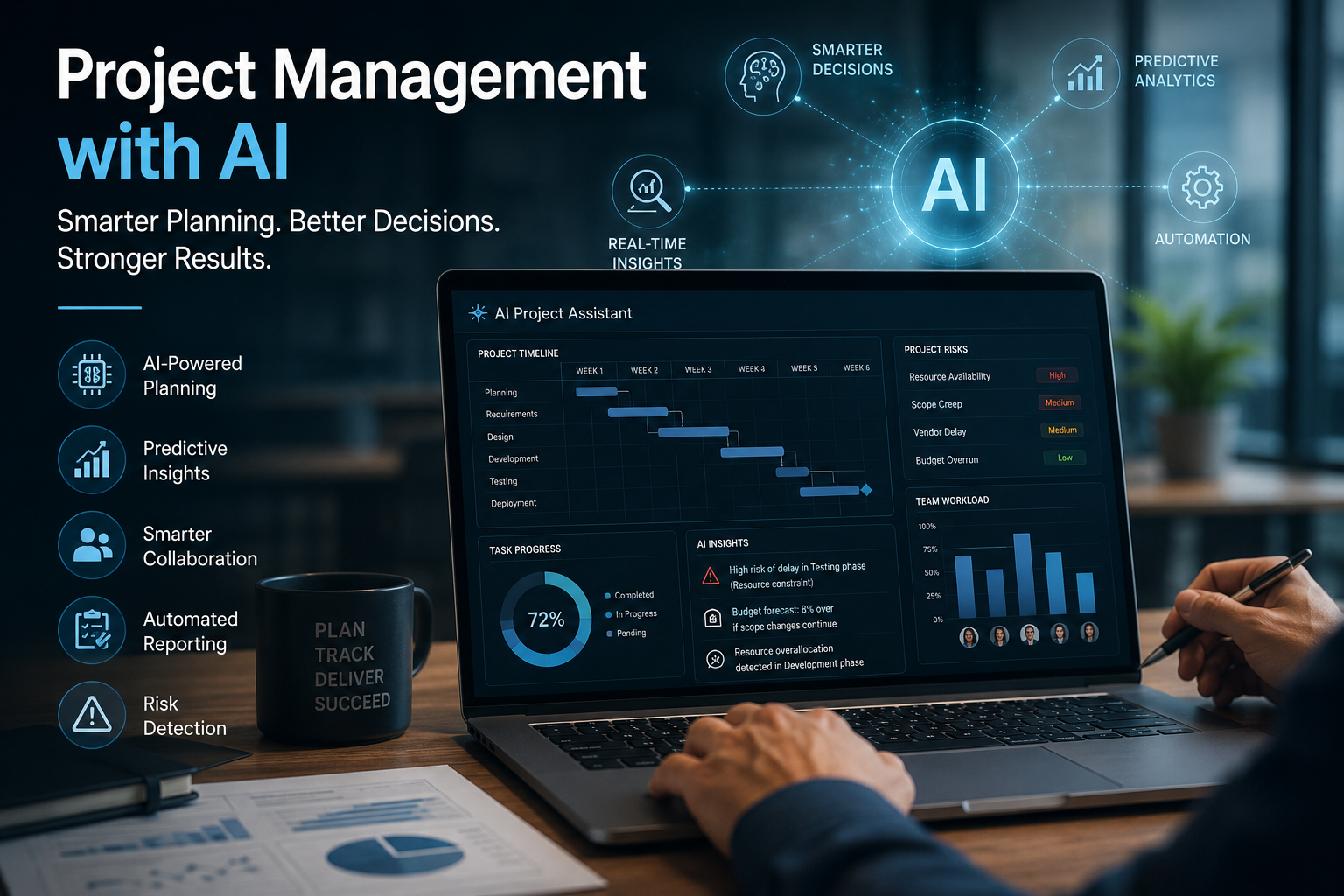
Project management has always been about balancing competing priorities. Every project manager has experienced the challenge of coordinating people, managing budgets, adjusting timelines, communicating with stakeholders, and solving unexpected problems—all while keeping the project moving toward a successful outcome.
Today, those responsibilities are growing even more complex. Organizations are expected to deliver projects faster, manage larger volumes of information, coordinate increasingly distributed teams, and adapt quickly to changing business conditions. At the same time, expectations for quality, transparency, and accountability continue to rise.
Artificial intelligence is rapidly changing how organizations meet these challenges.
Despite the excitement surrounding AI, many misconceptions remain. Some believe AI will replace project managers entirely. Others assume AI is simply another productivity tool that automates meeting notes or generates project schedules.
The reality lies somewhere in between.
Artificial intelligence is not replacing project management—it is fundamentally transforming how project managers work. By automating repetitive administrative tasks, analyzing large amounts of project data, and providing decision support, AI enables project managers to focus on what matters most: leadership, communication, problem solving, and strategic decision-making.
Organizations that successfully integrate AI into their project management practices are already seeing improvements in efficiency, collaboration, and project outcomes. The companies that embrace this shift today will be better positioned to manage increasingly complex projects tomorrow.
Project Management Has Always Been About Better Decisions
When people think about project management, they often picture schedules, Gantt charts, task lists, and status meetings.
While these tools are important, they are only part of the equation.
At its core, project management is a continuous process of making decisions under uncertainty.
Should additional resources be assigned to a delayed task?
Which risks require immediate attention?
How will a change request affect the project timeline?
Is the current budget sufficient to complete the project successfully?
Should the team continue with the current plan or adjust priorities?
Project managers make dozens—sometimes hundreds—of these decisions throughout the life of a project.
Artificial intelligence does not eliminate uncertainty. Instead, it helps project managers make better-informed decisions by identifying patterns, organizing information, and surfacing insights that would otherwise take hours to discover manually.
Rather than replacing human judgment, AI strengthens it.
Where AI Creates Immediate Value
One of the greatest misconceptions about AI is that its value comes from replacing people.
In reality, AI delivers the greatest return when it removes low-value administrative work that consumes valuable time.
Many project managers spend a significant portion of their week performing repetitive tasks, including:
- Writing meeting summaries
- Updating project documentation
- Tracking action items
- Preparing executive status reports
- Monitoring project risks
- Scheduling meetings
- Organizing project files
- Following up on overdue tasks
While necessary, these activities often reduce the time available for leadership, coaching, stakeholder engagement, and strategic planning.
AI can dramatically reduce the administrative burden associated with these responsibilities.
For example, AI can automatically summarize meetings, identify action items, draft project updates, organize project documentation, and generate weekly progress reports in minutes rather than hours.
Instead of replacing project managers, AI allows them to spend more time managing projects and less time managing paperwork.
AI Throughout the Project Lifecycle
Artificial intelligence provides value during every phase of a project—not just during execution.
Project Initiation
Every successful project begins with a clear understanding of objectives, stakeholders, risks, and expected outcomes.
AI can assist teams by analyzing historical projects, identifying similar initiatives, recommending success metrics, and helping create comprehensive project charters.
Instead of starting from scratch, project teams begin with informed recommendations based on previous organizational knowledge.
Project Planning
Planning often requires considerable effort.
Teams estimate timelines, identify dependencies, allocate resources, assess risks, and build communication plans.
AI accelerates this process by helping generate work breakdown structures, recommending realistic timelines, identifying missing tasks, and highlighting potential scheduling conflicts before work begins.
Rather than replacing planning sessions, AI provides project managers with a stronger starting point for collaboration.
Project Execution
Execution is where complexity increases rapidly.
New risks emerge.
Stakeholder priorities shift.
Budgets change.
Team members become unavailable.
Unexpected issues arise.
AI continuously analyzes project information to identify potential delays, highlight tasks that require attention, and detect emerging trends that may affect project performance.
Instead of reacting after problems become visible, project managers gain earlier insight into developing issues.
Monitoring and Control
Project monitoring often involves collecting data from multiple systems, preparing dashboards, reviewing progress reports, and communicating updates.
AI streamlines much of this work by consolidating information, generating summaries, identifying trends, and producing customized reports for executives, clients, or project sponsors.
This enables faster communication while reducing the administrative workload associated with reporting.
Project Closeout
Project completion offers one of the greatest opportunities for organizational learning.
Unfortunately, lessons learned are frequently documented but rarely analyzed or reused.
AI can organize project documentation, summarize successes and failures, identify recurring risks, and build searchable organizational knowledge that improves future projects.
Instead of losing valuable experience after every project, organizations build continuously improving knowledge bases.
Predicting Problems Before They Become Expensive
One of AI's greatest strengths is recognizing patterns.
Traditional project management often identifies issues after they occur.
Deadlines are missed.
Budgets exceed expectations.
Quality problems become visible.
Resources become overloaded.
AI shifts organizations toward predictive project management.
By analyzing historical project data alongside current performance, AI can identify warning signs long before they become critical.
Examples include:
- Increasing schedule risk
- Resource overload
- Budget overruns
- Communication bottlenecks
- Scope expansion
- Delayed approvals
- Vendor performance concerns
Early visibility gives project managers additional time to respond before small issues become major disruptions.
This predictive capability represents one of the most significant advances in project management in decades.
AI Is Not a Substitute for Leadership
Despite rapid technological advancement, there are aspects of project management that remain fundamentally human.
Artificial intelligence cannot build trust.
It cannot inspire a struggling team.
It cannot negotiate between competing stakeholders.
It cannot resolve organizational politics.
It cannot understand organizational culture with the same depth as experienced leaders.
Project success still depends on communication, empathy, negotiation, adaptability, and leadership.
The most successful project managers will not be those who rely entirely on AI.
They will be those who combine AI-generated insights with professional judgment and experience.
Technology supports leadership—it does not replace it.
Common Mistakes Organizations Make
As organizations rush to adopt AI, many make similar mistakes.
Automating Broken Processes
If an inefficient process exists today, adding AI often accelerates the inefficiency rather than fixing it.
Organizations should improve workflows before automating them.
Ignoring Data Quality
Artificial intelligence depends on accurate information.
Incomplete project documentation, inconsistent reporting, or outdated data reduce the effectiveness of AI recommendations.
Improving operational data should be a priority before implementing advanced AI capabilities.
Expecting Immediate Transformation
AI is not a magic solution.
Organizations achieve the greatest results through gradual adoption, continuous improvement, and ongoing learning.
Small improvements accumulate into significant operational gains over time.
Forgetting the Human Element
Technology succeeds only when people embrace it.
Training, communication, and organizational change management remain essential components of successful AI implementation.
Practical Ways to Begin Using AI in Project Management
Organizations do not need to completely redesign their project management methodology overnight.
Many begin with small, high-impact improvements.
Consider starting by using AI to:
- Draft project charters
- Create meeting agendas
- Generate meeting summaries
- Build project schedules
- Develop communication plans
- Produce executive status reports
- Track project risks
- Organize project documentation
- Identify overdue action items
- Create lessons learned reports
These tasks consume significant administrative time while requiring relatively little strategic judgment, making them excellent candidates for AI assistance.
As confidence grows, organizations can expand AI into forecasting, resource optimization, predictive analytics, and operational decision support.
The Future of Project Management Is AI-Assisted
Project management has evolved dramatically over the past several decades.
Organizations moved from paper schedules to spreadsheets.
From spreadsheets to cloud-based collaboration.
From static reporting to real-time dashboards.
Artificial intelligence represents the next major evolution.
Future project managers will increasingly work alongside intelligent digital assistants capable of monitoring project health continuously, recommending corrective actions, forecasting delivery risks, automating documentation, and helping leaders make better decisions faster.
The role of the project manager will become less administrative and more strategic.
Success will depend not on managing every individual task manually, but on interpreting insights, leading teams, navigating uncertainty, and making informed decisions supported by intelligent technology.
Organizations that embrace AI thoughtfully today will build more resilient project management practices, deliver projects more efficiently, and create a lasting competitive advantage.
Final Thoughts
Artificial intelligence is changing project management, but not in the way many people expect.
The future does not belong to organizations that replace project managers with AI.
It belongs to organizations that empower project managers with AI.
When repetitive administrative work is automated, project managers gain the freedom to focus on the responsibilities that create the greatest value: building relationships, solving complex problems, guiding teams through uncertainty, and delivering meaningful business outcomes.
At Kimemasu, we believe AI is most powerful when combined with strong operational practices, effective leadership, and data-driven decision-making. Technology alone cannot guarantee project success—but when paired with well-designed processes and experienced people, it becomes a catalyst for smarter planning, faster execution, and better results.
As AI continues to evolve, organizations that invest in both their people and their processes will be best positioned to deliver successful projects in an increasingly complex world. The future of project management is not human or artificial intelligence alone—it is the partnership between the two, working together to achieve outcomes that neither could accomplish as effectively on its own.