
How to Build an AI-Ready Operations Stack Without Overengineering Your Business

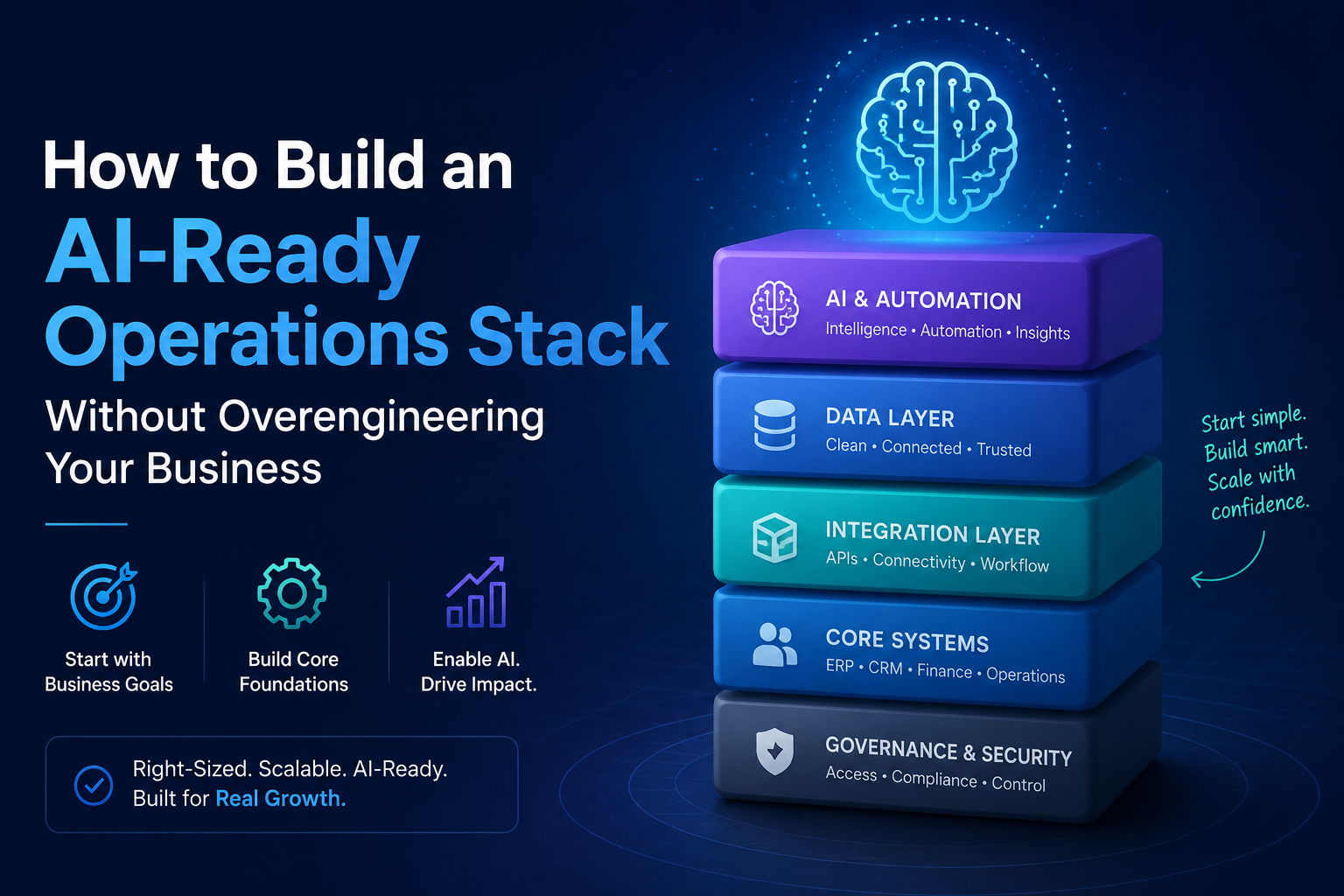
Artificial intelligence is reshaping how companies operate, but the businesses getting the best results are not the ones piling up the most software. They are the ones building a clean, connected, and practical operations stack that supports decision-making without creating unnecessary complexity. That is especially important for small and mid-sized businesses, where every system needs to earn its place.
An AI-ready operations stack is not about chasing the latest trend. It is about creating the right foundation so AI, automation, and data can actually improve the business. When the stack is well designed, teams spend less time searching for information, managers get better visibility, and repetitive work becomes easier to manage. When the stack is overbuilt, the opposite happens: employees get confused, data gets fragmented, and the business ends up paying for tools it barely uses.
The goal is simple. Build a system that helps the business run better today and stay flexible enough to grow tomorrow.
What an AI-ready operations stack really is
An AI-ready operations stack is the combination of tools, workflows, and data structures that allows a business to use AI effectively. It usually includes a way to capture leads or requests, a system of record for customers or jobs, task or workflow management, reporting, communication tools, and document storage. AI fits into that stack where it can reduce manual work, summarize information, classify data, or support decisions.
The important part is not that every step is automated. The important part is that information moves cleanly from one part of the business to the next. If a request comes in one place, gets updated in another, and is reported somewhere else, the business needs a consistent structure to keep everything aligned. Without that structure, AI becomes a novelty rather than a business tool.
A good stack makes the business easier to manage. A bad one adds friction. That difference matters because AI is only as useful as the environment it operates in.
Start with the business problem
One of the biggest mistakes businesses make is starting with software instead of the problem they need to solve. They buy a platform, test a chatbot, or connect a few tools and assume the system will create value on its own. But AI does not fix unclear processes. It amplifies whatever system already exists.
The better question is: what is actually slowing the business down?
For some companies, the biggest issue is poor lead response time. For others, it is inconsistent job tracking, messy reporting, repeated administrative work, or a lack of visibility into performance. Once the problem is defined clearly, it becomes much easier to choose the right combination of tools and workflows.
A business should identify the three most painful areas in its operation. These are usually the places where people ask the same questions repeatedly, where managers spend too much time chasing updates, or where errors happen because the process depends on memory instead of structure. That is where AI and automation can create the biggest return.
Simplicity beats sophistication
Many companies think modernization means adding more software. In reality, the best operations stacks are often the simplest ones. A stack does not need to be complicated to be effective. It needs to be consistent, connected, and easy for the team to use.
A practical stack might include one place to store customer or job information, one place to manage tasks, one place to store documents, one reporting layer, and one AI layer for tasks like drafting, summarizing, or sorting information. That may not sound impressive on paper, but it often works better than a stack full of disconnected systems.
Overengineering usually creates more problems than it solves. Too many tools lead to duplicate data, extra logins, unclear ownership, and inconsistent processes. Employees waste time moving between systems rather than doing productive work. The best stack reduces friction instead of multiplying it.
If a tool does not make the operation cleaner, faster, or easier to understand, it probably does not belong in the stack.
Data quality comes first
AI depends on data quality. If the business uses inconsistent labels, incomplete records, duplicate entries, or unclear categories, the results will be weak. That is why the first step in building an AI-ready operation is not choosing the AI tool. It is making the data usable.
The business should standardize the most important fields. These may include customer name, contact source, date, status, priority, service type, owner, and outcome. The more consistent these fields are, the more useful the data becomes for reporting, forecasting, and automation.
This also makes the business more scalable. When data is structured properly, new employees can learn the process more quickly. Managers can trust the reports. AI tools can summarize, classify, and analyze information with much better accuracy.
Poor data is one of the hidden costs of business growth. It creates confusion, slows decisions, and undermines confidence in the numbers. Clean data is not glamorous, but it is one of the most powerful operational advantages a company can build.
Pick tools that work together
The best operations stack is not built around one perfect platform. It is built around tools that communicate well with each other. Integration matters because every manual handoff between systems introduces risk. A lead captured in one app, copied into another, and reported in a third creates opportunities for delay and error.
Before choosing a tool, ask a few practical questions:
- Can it store the information we actually need?
- Can it connect to our existing workflow?
- Can it export data cleanly?
- Can it automate repetitive tasks?
- Can it support reporting without manual work?
If the answer is no to most of those questions, the tool may create more friction than value. A strong stack should reduce the number of times employees have to re-enter information. It should also make reporting more reliable and consistent.
Compatibility matters more than flash. A straightforward system that fits the business will outperform a more advanced system that nobody uses well.
Use AI where it saves time
AI is most useful in parts of the business that are repetitive, text-heavy, or rules-based. It works well when the task needs speed and consistency more than deep judgment. That is why it is especially valuable for summarizing notes, drafting messages, classifying requests, and extracting key information from long documents.
Some of the best AI use cases include:
- Drafting standard customer responses.
- Turning meeting notes into action items.
- Summarizing weekly performance data.
- Categorizing incoming leads or requests.
- Extracting details from forms or emails.
- Producing first-pass reports or internal summaries.
These tasks often consume a lot of time but do not require creative decision-making from scratch. AI can take care of the first draft or the first layer of sorting, and then people can review and refine it. That frees the team to focus on higher-value work.
The key is to keep AI in the right role. It should support the process, not replace human judgment where the stakes are high.
Build for adoption, not perfection
A system is only useful if the team uses it consistently. That means the best stack is one people can understand quickly and follow without confusion. Many businesses fail here because they create a technically strong system that is operationally difficult.
Adoption improves when the process is simple and the benefit is obvious. Employees should know exactly where to enter information, how often to update it, and what to do when something changes. If the workflow depends too much on interpretation, the team will create shortcuts, and the system will slowly break down.
To improve adoption:
- Keep naming conventions consistent.
- Limit the number of tools people need daily.
- Use automation only where it makes the process easier.
- Document the workflow in plain language.
- Review and simplify the system regularly.
The best operations stacks evolve gradually. They start small, prove useful, and then expand. That is far more effective than trying to roll out a massive transformation all at once.
Reporting should support decisions
One of the biggest reasons to build an AI-ready stack is to improve reporting. But reporting should not just show what happened. It should help leaders understand what to do next. A good reporting system highlights bottlenecks, trends, risks, and opportunities.
Useful metrics might include response time, lead conversion rate, job completion time, revenue per job, margin by service type, error rate, and repeat customer rate. These numbers give the business a clearer view of what is working and what needs attention.
AI can make reporting faster by summarizing patterns or generating first-draft analysis, but the structure has to be solid first. If the underlying data is messy, the report will be misleading. If the report is too complicated, nobody will use it. The goal is a reporting system that is simple enough to trust and strong enough to guide action.
Don’t automate chaos
A dangerous mistake many businesses make is automating a broken process. If the workflow is unclear, inconsistent, or full of exceptions, automation will not solve the problem. It will just make the problem happen faster.
That is why process design comes before automation. The business should first define how the process is supposed to work. Then it should clean up the data, remove unnecessary steps, and identify the repeatable parts that can be standardized. After that, AI and automation can be added with much better results.
This approach prevents businesses from locking bad habits into software. It also makes the final system easier to train, easier to improve, and easier to trust.
A practical rollout plan
Businesses do not need to rebuild everything at once. In fact, they should not. A phased approach is usually better because it lowers risk and increases adoption.
A simple rollout plan looks like this:
- Choose one pain point.
- Map the current workflow.
- Standardize the core data fields.
- Select the smallest useful tool set.
- Add AI where it clearly saves time.
- Test the process with a small group.
- Measure the results and refine.
This method keeps the business focused. It also creates momentum because each improvement shows immediate value. Over time, those improvements compound into a much stronger operating system.
Why this matters now
AI is becoming more embedded in everyday operations, but many businesses are still early in their adoption. That creates a major opportunity. Companies that build the right foundation now will be better positioned to use future tools quickly and effectively. Companies that wait will spend more time cleaning up disorder before they can get value from the technology.
Being AI-ready does not mean being the most advanced business in the market. It means being organized enough to benefit from modern tools without being overwhelmed by them. That is a practical advantage, not a theoretical one.
The businesses that win will be the ones that combine clear processes, clean data, simple systems, and smart use of automation. That is what creates a durable operational edge.
Conclusion
An AI-ready operations stack should make a business simpler to run, not harder. It should connect the most important parts of the operation, reduce manual work, improve reporting, and create better decision-making without adding unnecessary complexity. The best systems are not the most impressive-looking ones. They are the ones people actually use and trust.
If a business wants to benefit from AI, the first step is not buying another platform. It is building the foundation that makes AI useful in the first place. Once that foundation is in place, the business can scale with more confidence, make better decisions faster, and run with far less friction.
If you want, I can also turn this into a polished SEO version with title tag, meta description, slug, and section headers formatted for WordPress.