
Vendor Sprawl Is Killing Your Efficiency — Here's How to Fix It

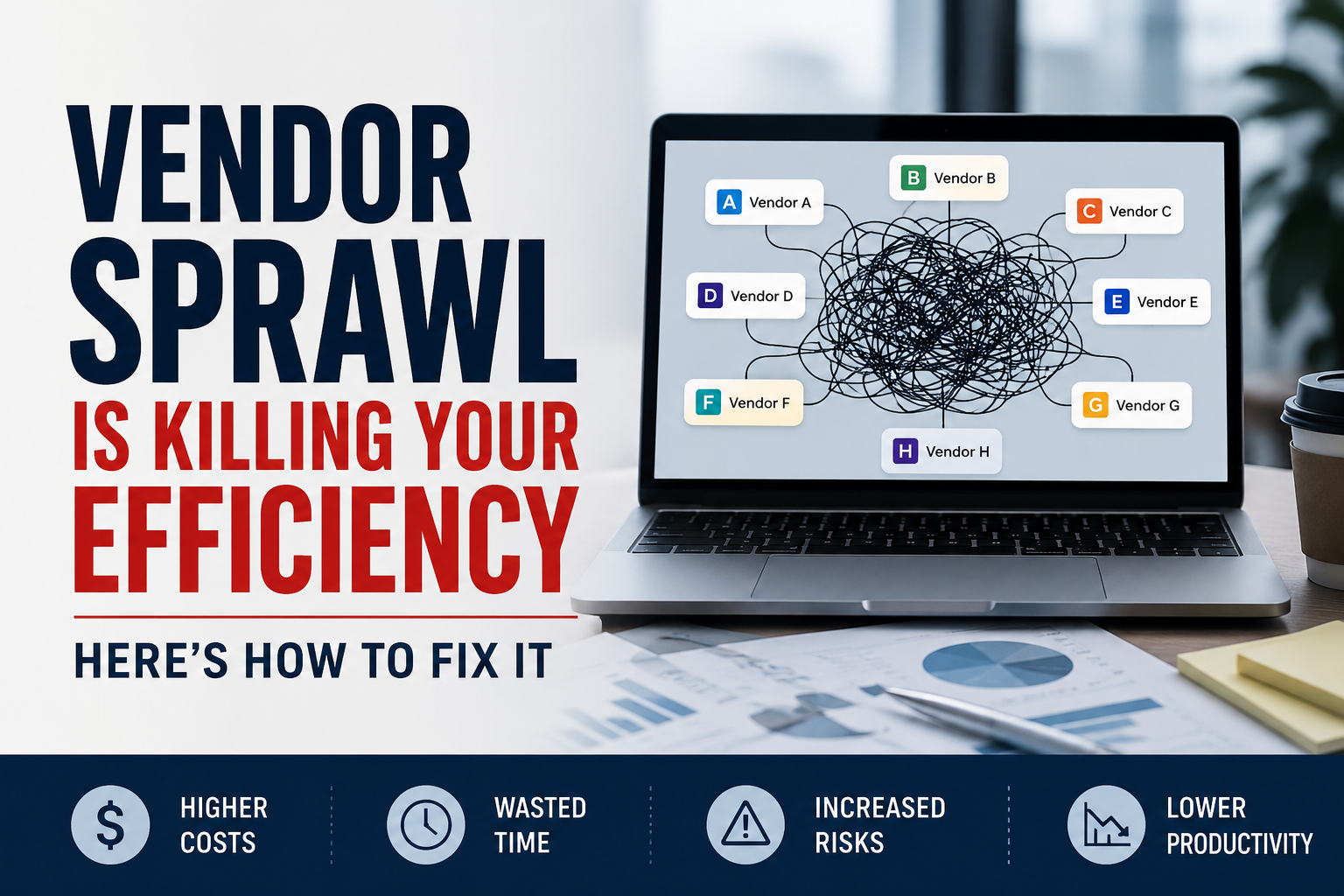
There is a pattern that shows up in nearly every growing business we work with, and it rarely announces itself loudly.
It starts reasonably enough. Your sales team needs a CRM, so you subscribe to one. Your operations team wants a project management tool, so they sign up for something that looked good in a demo. Marketing picks up a scheduling platform. Finance adds an expense tracker. HR brings in an onboarding tool. Someone on the product team expenses a design application. A department head discovers a reporting tool that solves a specific problem and adds it to their monthly spend.
None of these decisions were wrong in isolation. Each one made sense at the time. But zoom out twelve months later, and the picture looks different. You are now running on twenty, thirty, sometimes fifty or more software subscriptions — many of which overlap, few of which talk to each other, and some of which nobody on your team can confidently explain the purpose of anymore.
This is vendor sprawl. And according to research published in 2025, 87 percent of mid-market organizations report that it has a moderate to major financial impact on their business. Fifty-one percent of those same organizations report having between 100 and 300 SaaS tools active in their tech stack at any given time. Forty-one percent are adding new tools every one to three weeks.
The cost is not just financial, though the financial cost is significant. The deeper damage is operational — and that is what most leaders are not measuring.
Why Vendor Sprawl Feels Normal Until It Does Not
One of the reasons vendor sprawl is so difficult to catch early is that it mimics good organizational behavior. Teams adopting tools are teams trying to solve problems. Managers approving new subscriptions are managers who want their people to have what they need. The culture of adopting the best tool for the job is, in most ways, a healthy one.
The problem emerges not from any single decision but from the absence of a system governing all of them together. Without centralized visibility into what tools exist, what they cost, who uses them, and what they are supposed to do, individual good decisions quietly accumulate into a collective inefficiency.
What does that inefficiency actually look like in practice?
It looks like a sales team and a marketing team both paying for separate platforms that perform identical functions because they were adopted independently and no one connected the dots. It looks like an employee who left the organization six months ago whose software licenses are still active and billing monthly. It looks like three different departments maintaining their own project trackers that do not sync, requiring a fourth tool — or a manual process — to consolidate the information for leadership.
It looks like a data environment where the same metric shows different numbers in different systems, and no one can tell you with confidence which one is right.
Every one of these scenarios is a direct operational cost. And most organizations are carrying several of them simultaneously without realizing it.
The Three Ways Sprawl Drains Your Organization
Understanding how vendor sprawl specifically damages operations helps clarify why fixing it deserves the same urgency as any other cost-reduction initiative.
The Financial Drain
The most visible cost of vendor sprawl is the direct spend on software that is redundant or underused. Research from Litcom found that organizations that conduct a structured rationalization of their SaaS environment typically achieve a 30 to 50 percent reduction in duplicate tools per category, and between 10 and 25 percent in savings from renegotiating contracts, right-sizing licenses, and eliminating subscriptions that nobody actively uses.
For a business spending $200,000 annually on software — not an unusual figure for a company with 50 or more employees — that represents $20,000 to $50,000 in recoverable spend, often without losing a single capability the business actually needs. Beyond the direct license cost, there is also the overhead cost of managing a large vendor portfolio: contracts to track, renewals to monitor, invoices to reconcile, and vendor relationships to maintain. That administrative burden falls somewhere in your organization, and it is not free.
The Operational Friction
Fragmented tools create fragmented workflows. When data lives in multiple systems that are not integrated, information transfer becomes a manual task — and manual tasks are slow, error-prone, and invisible to the people who depend on that information arriving accurately and on time.
Teams working in disconnected systems spend meaningful hours each week doing work that should be automated: exporting from one platform, reformatting, and importing into another. Sales loses context when moving from a lead tool to a CRM. Finance spends time reconciling figures that two systems report differently. Operations waits on updates that require someone to manually consolidate inputs from three separate trackers.
Nearly a third of IT leaders in the Nintex research cited above identified disconnected systems as a major contributor to subpar customer experiences. That is not a back-office problem. It is a competitive one.
The Security and Compliance Exposure
Every software application in your environment is a potential entry point — for data breaches, for compliance failures, and for unauthorized access. When tools proliferate without governance, the security posture of the organization degrades in proportion. Former employees retain access to platforms that IT did not know to deactivate. Sensitive data flows into applications that were never reviewed for compliance. Permissions accumulate over time as people change roles, with no systematic process for pruning what they no longer need.
This is not a theoretical risk. In 2022, a major telecommunications company suffered a significant data breach traced directly to a misconfiguration in a cloud environment — the kind of oversight that is far more likely in an unmanaged, sprawling tech stack than in a rationalized, governed one.
What a Rationalized Tech Stack Actually Looks Like
Solving vendor sprawl is not about minimalism for its own sake, or about forcing every team to use a single platform that meets none of their needs particularly well. It is about intentionality — having a clear, current, governed inventory of the tools in your environment and ensuring that each one is earning its place.
Organizations that successfully address vendor sprawl typically move through four phases.
Visibility first. You cannot govern what you cannot see. The starting point is always a complete inventory of every active subscription in the organization — pulled from expense systems, corporate card statements, procurement records, and IT logs. This step alone is frequently revealing. Most organizations discover tools they forgot they were paying for, duplicate subscriptions in different departments, and licenses significantly in excess of active usage.
Rationalization. With a complete inventory in hand, the next step is to assess each tool against a consistent set of questions. Does it have functional overlap with another tool in the stack? Is it being actively used by the people it was licensed for? Does it integrate cleanly with the systems it needs to connect to, or does it require manual workarounds? Is the pricing tier appropriate for actual usage? This analysis produces a clear picture of what to keep, what to consolidate, what to renegotiate, and what to retire.
Standardization. For categories where multiple tools are doing the same job, standardization means selecting a preferred platform and migrating users to it. This is the step that generates the most immediate cost savings and the most meaningful reduction in operational complexity. It is also where resistance tends to appear — teams are attached to the tools they know, and consolidation requires managing that transition carefully. The payoff, however, is a tech environment where data flows more consistently, onboarding is simpler, and the ongoing cost of managing vendor relationships drops significantly.
Governance. The final phase is the one that determines whether the improvement is permanent or temporary. Without a clear process for evaluating and approving new software purchases, the conditions that created the sprawl in the first place will simply reassert themselves. Effective governance does not need to be complex. At a minimum, it means designating clear ownership for each tool in the environment, establishing a lightweight review process before new subscriptions are approved, and scheduling regular audits to identify drift before it becomes entrenched.
The Compounding Cost of Waiting
There is a timing argument for addressing vendor sprawl that is worth being direct about.
The longer an organization waits to rationalize its tool environment, the more expensive and disruptive the rationalization becomes. Every month of inaction is another month of redundant subscriptions billing, another month of integration debt accumulating, another month of data flowing into systems that will eventually need to be consolidated or migrated. Organizations that address sprawl proactively — before it becomes a crisis — do so with far less disruption and at far lower cost than those who wait until the inefficiency becomes impossible to ignore.
There is also a competitive dimension. The businesses that operate on lean, well-integrated tech stacks move faster than those that do not. Their data is more reliable. Their processes require less manual intervention. Their teams spend more time on work that creates value and less time managing the overhead of a fragmented environment. That speed and reliability compounds over time. It shows up in customer experience, in operational capacity, and ultimately in margin.
Where to Begin
If you have been reading this and cataloguing your own tech stack in your head, that instinct is the right one to follow.
The first step is simply to get a complete picture of what you are running. Pull the subscriptions, map the costs, and start asking the basic questions: What does this tool do? Who uses it? Does something else in the environment already do it? If you stopped paying for it tomorrow, who would notice?
The answers will tell you more about your operational health than most metrics on your dashboard — and they will almost certainly identify savings and improvements that are available right now, without new technology, new headcount, or a long implementation project.
Sometimes the most significant operational improvement a business can make is not adding something new. It is finally deciding to stop paying for things that are quietly working against you.