
Why Operational Agility Matters More Than Ever in 2026

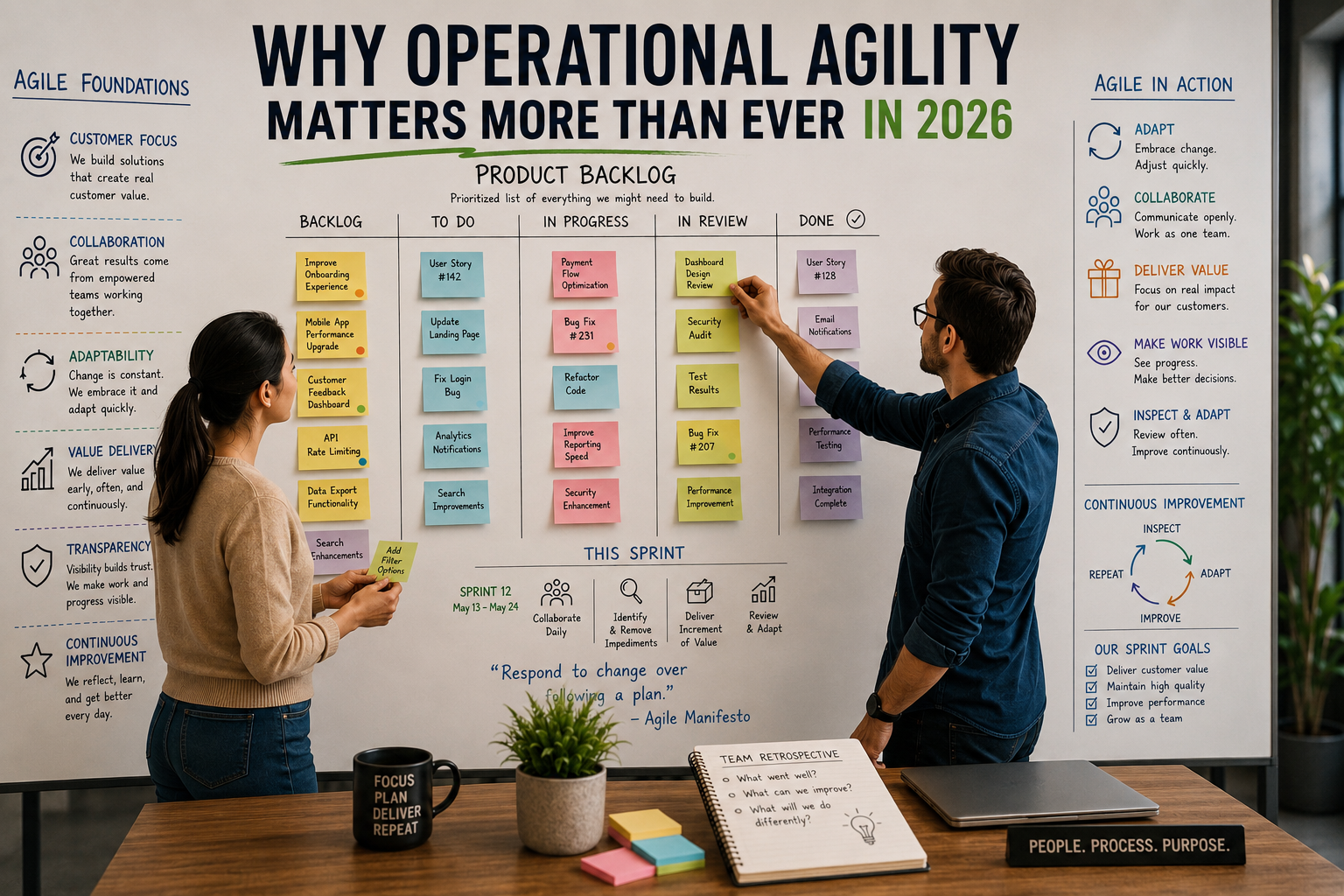
Every business wants to grow. Leadership teams want stronger execution, improved efficiency, better communication, and faster results. Yet despite investing in technology, hiring talent, and expanding operations, many organizations still struggle with one major issue: operational friction.
Teams become overwhelmed. Priorities constantly shift. Communication breaks down between departments. Workflows become more complicated as businesses grow. Meetings increase, but clarity often decreases. Many organizations are moving quickly, but they are not always moving effectively.
This is exactly why operational agility has become one of the most important business advantages in 2026.
Operational agility is the ability of an organization to adapt, respond, and execute effectively as conditions change. It is not simply about speed. It is about creating systems, workflows, and teams that can remain aligned, organized, and responsive in increasingly complex business environments.
The companies performing well today are not necessarily the ones working the hardest. More often, they are the ones operating with the most clarity.
The End of Rigid Business Operations
For years, many organizations operated through rigid planning structures and slow-moving approval systems. Long timelines, siloed departments, and top-heavy communication models were considered normal business practices. But today’s environment changes too quickly for outdated operational systems to keep pace.
Customer expectations evolve rapidly. Market conditions shift unexpectedly. Internal priorities change faster than ever before. Businesses are expected to make smarter decisions in less time while managing growing operational complexity.
When organizations lack operational flexibility, even small inefficiencies quickly become larger problems.
A delayed approval process slows execution. Miscommunication between departments creates duplicated work. Disconnected systems reduce visibility into performance. Leadership struggles to identify bottlenecks, and employees spend more time reacting to issues instead of improving outcomes.
Over time, operational inefficiency becomes expensive.
This is why businesses across industries are beginning to rethink how work gets done.
Operational agility helps organizations create systems that are flexible enough to adapt without sacrificing accountability or structure. Instead of relying entirely on rigid planning cycles, agile organizations focus on continuous improvement, collaboration, and operational visibility.
The goal is not to create chaos or constant change. The goal is to create responsiveness.
Why Agile Thinking Is Expanding Beyond Technology
Many people still associate Agile and Scrum with software development teams, but Agile principles are now influencing operations management, consulting, analytics, marketing, logistics, finance, and strategic planning.
The reason is simple.
Businesses today need adaptability more than ever before.
Traditional operational models often struggle because they rely heavily on static assumptions and long-term planning structures that cannot adjust quickly when priorities change. Agile thinking encourages organizations to create workflows that evolve continuously instead of remaining fixed.
Rather than waiting months to identify operational problems, Agile organizations prioritize shorter feedback loops, ongoing communication, and continuous evaluation.
This creates stronger alignment across teams and allows businesses to respond more effectively to changing conditions.
More importantly, Agile creates flexibility without removing structure.
That balance matters.
Operational agility does not mean abandoning strategic planning or constantly changing direction. Strong agile organizations still maintain accountability, priorities, timelines, and operational discipline. The difference is that they build systems capable of adapting instead of breaking under pressure.
In many ways, Agile operational thinking is simply a smarter way to manage complexity.
Where Scrum Fits Into Operational Agility
One of the reasons Scrum has become so widely adopted is because it creates structure around adaptability.
Many organizations struggle because priorities constantly shift, but teams lack a clear process for managing those changes effectively. Projects lose momentum, communication gaps increase, and execution slows down because work becomes reactive instead of intentional.
Scrum helps solve this problem by creating a framework for continuous progress and operational alignment.
Instead of managing projects through large, rigid timelines, Scrum breaks work into smaller focused cycles called sprints. Teams review progress regularly, identify obstacles early, and adjust priorities in real time. This creates more visibility across workflows and allows organizations to respond faster without losing operational clarity.
What makes Scrum valuable outside of software development is that its principles apply to almost any operational environment.
Marketing teams can use Scrum to improve campaign coordination and collaboration. Operations teams can use it to streamline workflows and reduce inefficiencies. Consulting teams can use it to manage priorities more effectively while improving communication with stakeholders and clients.
At its core, Scrum encourages transparency, accountability, communication, and continuous improvement.
These are the same qualities organizations need to remain agile in modern business environments.
Many businesses assume inefficiency comes from employees not working hard enough, when in reality the problem is usually operational misalignment. Teams may be putting in significant effort, but unclear priorities, inconsistent communication, and disconnected workflows reduce effectiveness.
Scrum creates operational rhythm.
Daily standups, sprint reviews, retrospectives, and collaborative planning sessions help teams stay aligned while continuously improving execution. Instead of waiting until the end of a project to identify issues, teams can adapt throughout the process.
This responsiveness becomes increasingly valuable as organizations scale.
Visibility Is the Real Operational Advantage
One of the biggest operational problems many companies face is lack of visibility.
Leadership teams often do not have a clear understanding of where workflows slow down, where communication gaps exist, or where inefficiencies are quietly reducing productivity.
Many organizations operate with fragmented systems, disconnected data, and inconsistent processes. Teams work hard, but operational clarity is missing.
Without visibility, improvement becomes difficult.
This is why operational agility is closely connected to operational transparency. Agile organizations prioritize communication, workflow visibility, and continuous evaluation because they understand that businesses cannot improve what they cannot clearly see.
Shorter planning cycles, more collaborative workflows, and clearer accountability structures help organizations identify problems earlier instead of reacting after inefficiencies become costly.
In many ways, operational agility is really about reducing friction.
It is about creating systems where work flows more effectively, communication improves, and teams can adapt without constantly feeling overwhelmed by operational complexity.
Growth Naturally Creates Complexity
One of the most overlooked operational realities businesses face is that growth naturally creates complexity.
As organizations expand, they add more employees, more systems, more projects, more communication channels, and more decision-makers. Without adaptable operational structures, growth can actually slow a company down.
This is something many businesses experience firsthand.
Processes that worked well with a small team suddenly become inefficient at scale. Communication becomes harder. Priorities become less clear. Teams begin operating in silos. Operational confusion increases even while the company itself is growing.
Operational agility helps organizations scale more effectively because it creates operational systems capable of evolving alongside the business.
Instead of rebuilding workflows every time the organization grows, agile operational structures allow businesses to adapt more naturally over time.
This creates stronger long-term sustainability and operational consistency.
The Human Side of Operational Agility
Operational agility is not only about workflows and systems. It also affects organizational culture.
Companies with rigid operational structures often struggle with communication fatigue, employee frustration, and decision-making delays. Teams may feel disconnected from leadership, unclear about priorities, or overwhelmed by inefficient processes.
Agile operational environments tend to encourage more collaboration, responsiveness, and accountability.
Employees are more likely to contribute ideas and identify operational improvements when communication is open and teams feel empowered to solve problems. This creates stronger engagement and often improves morale because employees can see how their work connects to larger organizational goals.
In 2026, this matters more than ever.
Businesses are competing not only for customers, but also for talent. Organizations that create adaptable and responsive operational cultures are often more attractive to high-performing professionals who value clarity, collaboration, and efficiency in their work environments.
Operational agility can improve employee experience just as much as operational performance.
Why Operational Agility Is Becoming a Competitive Advantage
The modern business landscape is shaped by constant change.
Economic uncertainty, digital transformation, evolving customer expectations, remote and hybrid work environments, cybersecurity concerns, and increasing competition are forcing organizations to become more adaptable than ever before.
Businesses that cannot respond effectively to change often struggle to maintain momentum.
Operational agility allows organizations to remain stable while adapting quickly. Instead of becoming overwhelmed by disruption, agile businesses create systems capable of absorbing change more effectively.
This creates resilience.
And resilience is becoming one of the most valuable business assets organizations can build.
Companies that improve operational agility are often better positioned to improve execution, reduce inefficiencies, strengthen collaboration, adapt to market changes, improve customer experience, and support long-term growth.
The organizations that succeed in the future will likely be the ones that combine strategic clarity with operational flexibility.
Operational Agility Is Ultimately About Clarity
One of the biggest misconceptions about operational improvement is that businesses need more tools, more meetings, or more complexity to become more effective.
In reality, most organizations need more clarity.
They need clearer communication, clearer priorities, clearer workflows, and clearer visibility into how work moves across the business.
Operational agility creates that clarity.
When organizations improve communication, reduce bottlenecks, and create adaptable systems, teams become more aligned and execution becomes more effective. Employees spend less time reacting to confusion and more time creating meaningful progress.
This is one of the reasons operational agility is becoming such an important leadership priority in 2026.
Businesses are no longer competing only on products or services. They are competing on execution.
The organizations that can adapt quickly, communicate clearly, and continuously improve their operations will often outperform companies with better ideas but weaker operational systems.
Operational agility is no longer just a management philosophy. It is becoming a defining characteristic of resilient, scalable, and high-performing organizations.
Final Thoughts
Operational agility is no longer a niche concept reserved for startups or technology companies. It is becoming a foundational business capability for organizations that want to grow, scale, and remain competitive in rapidly changing environments.
Businesses today need more than productivity. They need adaptability. They need visibility. They need systems that support continuous improvement instead of creating unnecessary friction.
Agile thinking, Scrum frameworks, operational clarity, and responsive workflows are helping organizations rethink how work gets done.
The goal is not simply to move faster. The goal is to operate smarter.
In 2026, businesses that prioritize operational agility are putting themselves in a stronger position to navigate complexity, improve execution, and create long-term operational stability in an environment where change is no longer occasional — it is constant.