
Why You Shouldn't Fear Artificial Intelligence: Understanding the Technology That's Reshaping Business

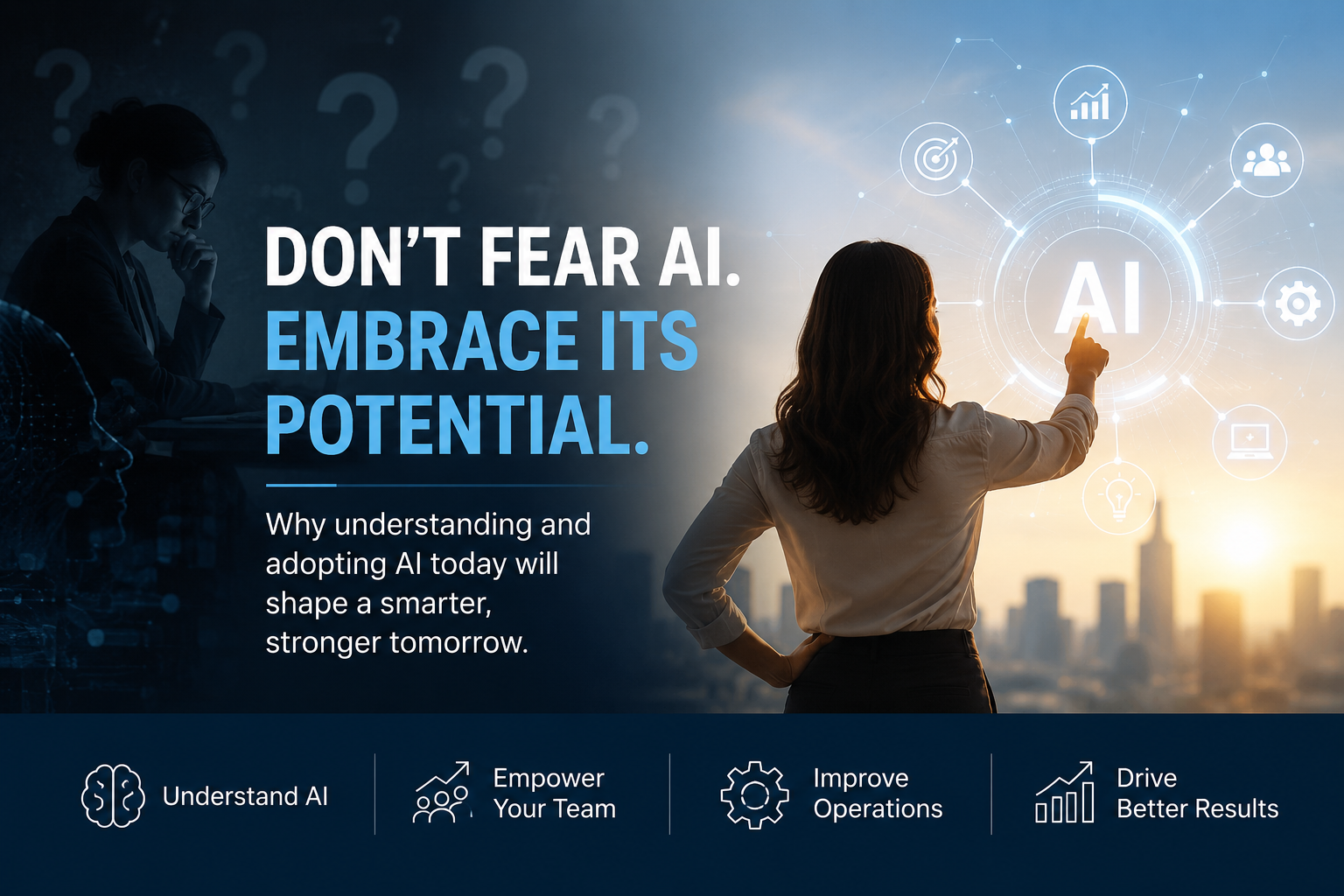
The Fear of AI Is Real — But Is It Justified?
Artificial Intelligence has become one of the most discussed technologies in the world. Nearly every week, headlines warn about AI replacing jobs, transforming industries, or fundamentally changing how we work. For many business owners, employees, and executives, these developments can feel overwhelming.
It's understandable.
Whenever a transformative technology emerges, uncertainty follows. The internet created fear. Cloud computing created fear. Automation created fear. Even email was once viewed as a disruptive force that would dramatically change how businesses operated.
Today, AI occupies that same position.
The difference is that AI is advancing faster than most previous technologies, making it feel less predictable and more intimidating. Many people worry that AI will replace workers, eliminate jobs, remove the human element from business, or create a future where technology makes critical decisions without human oversight.
While these concerns are understandable, they often overshadow a more important reality:
AI is not primarily about replacing people. It's about helping people work smarter, make better decisions, and focus on higher-value activities.
Businesses that understand this distinction are positioning themselves for future success. Those that allow fear to prevent exploration may find themselves at a competitive disadvantage in the years ahead.
Why People Are Afraid of AI
Fear surrounding AI generally falls into four categories.
1. Fear of Job Loss
This is perhaps the most common concern.
Employees worry that AI will automate their roles and make their skills obsolete. Business leaders worry that implementing AI may disrupt their workforce or create internal resistance.
The reality is more nuanced.
While certain repetitive tasks may become automated, history consistently shows that technological advancement tends to change jobs rather than eliminate work entirely. New technologies often create new roles, new opportunities, and new ways of delivering value.
In many organizations, AI is already being used to assist employees rather than replace them.
For example:
- Customer service representatives use AI to draft responses.
- Marketers use AI to generate content ideas.
- Analysts use AI to identify patterns in large datasets.
- Project managers use AI to summarize meetings and action items.
The employee remains essential. The technology simply enhances efficiency.
2. Fear of Losing Control
Many people worry that AI operates like a "black box" that makes decisions independently.
In reality, effective AI implementation involves human oversight.
AI can analyze information quickly, identify trends, and generate recommendations. However, business decisions still require human judgment, experience, ethics, and context.
Organizations that successfully implement AI understand that human expertise remains the most valuable component of the decision-making process.
3. Fear of Complexity
Many business owners assume AI requires massive budgets, advanced technical knowledge, and extensive infrastructure.
This misconception prevents many organizations from exploring opportunities that could immediately improve operations.
Modern AI solutions are more accessible than ever.
Businesses can begin using AI for:
- Process documentation
- Customer communication
- Data analysis
- Reporting
- Scheduling
- Knowledge management
- Marketing support
Many of these applications can be implemented without major technology investments.
4. Fear of the Unknown
Perhaps the greatest source of AI anxiety is uncertainty.
People often fear what they do not fully understand.
When AI is presented as a futuristic technology capable of replacing entire industries, it becomes easy to imagine worst-case scenarios.
However, when AI is viewed as a practical business tool, the conversation changes dramatically.
Instead of asking:
"Will AI replace us?"
Organizations begin asking:
"How can AI help us work better?"
That shift in perspective is where meaningful transformation begins.
The Real Opportunity: Human + AI
One of the biggest misconceptions surrounding AI is the belief that humans and technology are competing against one another.
The most successful organizations recognize that the future is not Human versus AI.
The future is Human plus AI.
Artificial intelligence excels at:
- Processing large amounts of information
- Identifying patterns
- Automating repetitive tasks
- Generating drafts and summaries
- Supporting data-driven decisions
Humans excel at:
- Critical thinking
- Creativity
- Strategic planning
- Emotional intelligence
- Relationship building
- Ethical decision-making
When these strengths are combined, organizations can achieve significant improvements in productivity and effectiveness.
Rather than replacing human expertise, AI often amplifies it.
Why Businesses Can't Afford to Ignore AI
Many organizations believe they can wait until AI becomes more mature before taking action.
Unfortunately, that strategy carries risk.
AI adoption is accelerating across industries. Companies are increasingly integrating AI into operations, customer service, marketing, analytics, and decision-making processes. Organizations that delay exploration may eventually find themselves competing against businesses that operate faster, make decisions more effectively, and deliver better customer experiences.
The question is no longer whether AI will impact business.
The question is how prepared organizations will be when that impact becomes unavoidable.
Businesses that begin learning now gain a significant advantage.
AI Is Not a Technology Problem — It's a Change Management Challenge
One of the most important lessons emerging from successful AI implementations is that technology is rarely the biggest obstacle.
People are.
Organizations often invest in AI tools but fail to educate employees on how to use them effectively.
Without training and communication:
- Employees become skeptical.
- Adoption slows.
- Productivity gains never materialize.
- Fear increases.
Successful AI adoption requires:
Education
Employees need to understand what AI can and cannot do.
Transparency
Leaders should communicate openly about how AI will be used and why.
Training
People need practical guidance and opportunities to develop confidence.
Incremental Adoption
Organizations should begin with manageable use cases before expanding implementation.
Businesses that approach AI as an organizational transformation rather than simply a technology deployment achieve significantly better outcomes.
Practical Ways Small and Mid-Sized Businesses Can Use AI Today
For many organizations, AI feels overwhelming because they assume implementation must be large-scale.
In reality, some of the highest-value opportunities involve relatively simple applications.
Examples include:
Automating Administrative Work
AI can help draft emails, summarize meetings, create reports, and organize documentation.
Improving Customer Service
AI-powered assistants can answer common questions and provide faster support.
Enhancing Data Analysis
Organizations can uncover insights from operational data more quickly and accurately.
Supporting Marketing Efforts
AI can help generate content ideas, optimize messaging, and improve campaign performance.
Streamlining Knowledge Management
Internal knowledge bases become easier to search and maintain with AI-powered tools.
These applications allow businesses to realize immediate value while building organizational confidence.
The Organizations That Win Will Be the Ones That Learn
Every major technological shift creates two groups.
The first group resists change because of uncertainty.
The second group explores opportunities while managing risks responsibly.
Historically, the organizations that thrive are not necessarily the first adopters.
They are the fastest learners.
AI should not be approached recklessly.
It should be approached strategically.
Organizations should establish governance, evaluate risks, ensure compliance, and maintain human oversight.
At the same time, they should actively explore how AI can improve operations, reduce inefficiencies, and create better experiences for customers and employees.
Final Thoughts: Replace Fear with Understanding
Fear is a natural response to change.
But fear alone is not a strategy.
Artificial Intelligence is not a passing trend. It is becoming a foundational business capability that will continue influencing how organizations operate for years to come.
The businesses that benefit most from AI will not necessarily be those with the largest budgets or the most advanced technology.
They will be the organizations willing to learn, adapt, and embrace innovation responsibly.
Rather than asking whether AI should be feared, business leaders should ask a different question:
"How can we use AI to become more effective, more efficient, and more valuable to the people we serve?"
The answer to that question will shape the future of every organization.
At its best, AI is not a replacement for human intelligence.
It is a tool that helps human intelligence achieve more than ever before.