
Why Most Businesses Operate Reactively—and How to Shift to Proactive Operations

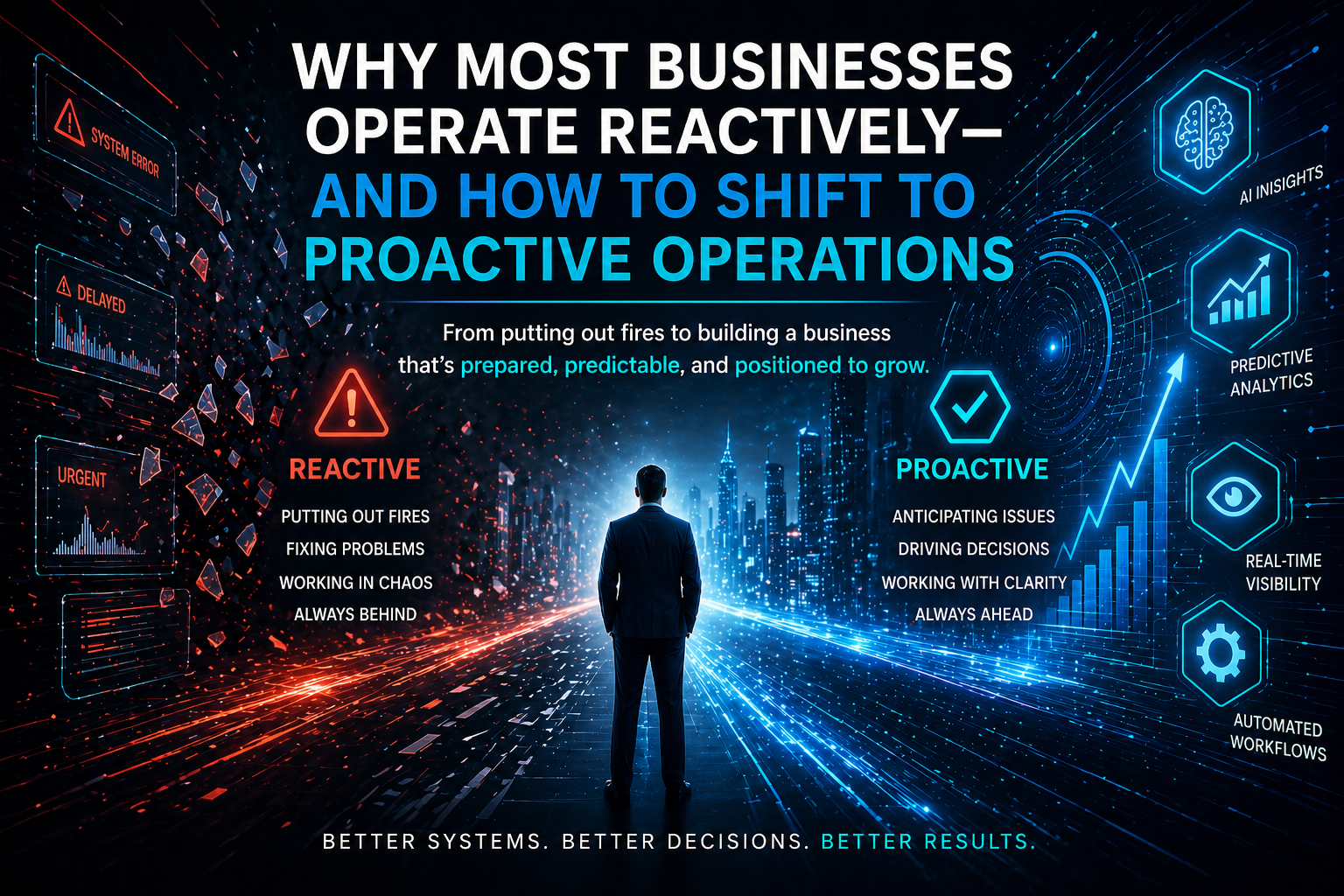
Most businesses do not set out to operate reactively.
No leadership team begins with the intention of constantly putting out fires, responding late to problems, or making decisions under pressure. In fact, most organizations believe they are building systems that support growth, efficiency, and control.
And yet, over time, many find themselves in a very different position.
Teams are constantly responding to issues rather than preventing them. Problems surface only after they’ve already impacted performance. Decisions are made quickly, but often too late to change the outcome. The organization becomes efficient at reacting, but not at anticipating.
This shift rarely happens all at once. It develops gradually, as complexity increases and systems fail to evolve alongside the business.
What begins as agility eventually turns into reactivity.
The Hidden Nature of Reactive Operations
Reactive operations are not always obvious from the outside.
In many cases, they are disguised as responsiveness. Teams move quickly, issues are addressed, and work continues. There is a sense of urgency and activity that can easily be mistaken for effectiveness.
But underneath that activity, there is a pattern.
Work is triggered by problems rather than by planning. Data is reviewed after performance changes rather than before. Communication increases not because of alignment, but because of confusion.
Over time, this creates an environment where the business is always slightly behind.
Not dramatically—but enough to feel it.
Leaders begin to notice that decisions are taking longer than expected. Teams spend more time coordinating than executing. Small issues require disproportionate effort to resolve. And despite working harder, the organization struggles to create consistent momentum.
This is the cost of operating reactively.
How Businesses Drift Into Reactivity
In the early stages of a company, reactive behavior often works.
Teams are small, communication is direct, and decisions can be made quickly. When an issue arises, it can be addressed immediately. There is little need for formal structure because the organization is simple enough to manage through conversation.
This environment rewards speed and flexibility.
But as the business grows, the same approach begins to break down.
More customers, more transactions, more tools, and more people introduce complexity. Work becomes distributed across teams, systems, and processes. What was once handled informally now requires coordination.
To manage this complexity, organizations add layers—more tools, more reporting, more communication.
However, if these additions are not designed intentionally, they do not create clarity.
They create fragmentation.
Information becomes scattered across systems. Processes vary between teams. Metrics are defined differently depending on the context. And as a result, the organization loses its ability to see clearly.
When visibility declines, anticipation becomes difficult.
And when anticipation becomes difficult, the organization defaults to reacting.
The Role of Data in Reactive Environments
One of the more surprising aspects of reactive operations is that they often exist alongside an abundance of data.
Most modern organizations have access to dashboards, analytics platforms, and reporting tools that provide detailed insights into performance. On the surface, it appears that they should be able to operate proactively.
But access to data does not guarantee action.
In reactive environments, data is typically used to explain what has already happened rather than to guide what should happen next. Reports are reviewed after results change. Metrics are analyzed after problems occur.
This creates a lag between information and action.
By the time insights are identified, the opportunity to influence outcomes has already passed.
The issue is not the lack of data.
It is the lack of integration between data and decision-making.
The Cost of Always Being Reactive
Operating reactively introduces a range of hidden costs that extend beyond immediate inefficiency.
One of the most significant is decision fatigue. When teams are constantly responding to new issues, they are required to make frequent, high-pressure decisions. Over time, this reduces the quality of those decisions and slows down execution.
Another cost is inconsistency. Without stable systems, outcomes depend heavily on individual effort. This makes it difficult to replicate success or maintain performance at scale.
There is also a cost to morale. Employees who are constantly reacting to problems often feel overwhelmed and unable to focus on meaningful work. Instead of building momentum, they feel as though they are maintaining stability.
Perhaps most importantly, reactive operations limit growth.
As the business expands, the volume of issues increases. Without proactive systems in place, the organization becomes constrained by its ability to respond.
Growth continues—but with increasing friction.
What Proactive Operations Actually Look Like
Proactive operations are not defined by the absence of problems.
They are defined by how those problems are anticipated and managed.
In a proactive organization, systems are designed to surface issues early. Data is structured in a way that highlights trends and signals, not just outcomes. Decisions are guided by clear frameworks rather than made in isolation.
Work flows predictably.
Teams are not constantly adjusting to unexpected changes because those changes are identified before they escalate. Communication becomes more focused, not more frequent. Effort is directed toward improving systems rather than reacting to breakdowns.
Most importantly, there is a shift in mindset.
Instead of asking, “What went wrong?” the organization begins to ask, “What could go wrong—and how do we address it before it does?”
This shift creates stability.
And stability creates scale.
Moving From Reaction to Design
Transitioning from reactive to proactive operations does not happen through effort alone.
It requires design.
The first step is to understand where reactivity exists within the organization. This often becomes visible in workflows that require constant intervention—areas where work slows down, errors occur, or communication increases unexpectedly.
These friction points are not random.
They are signals of underlying structural issues.
Once identified, the focus shifts to standardization. Processes that vary between teams or individuals need to be aligned. This does not mean removing flexibility, but it does mean creating consistency where it matters.
Consistency allows for predictability.
Predictability allows for anticipation.
At the same time, data needs to be restructured to support forward-looking decisions. This involves moving beyond historical reporting and identifying leading indicators—metrics that signal potential changes before they occur.
When these indicators are integrated into daily workflows, teams are able to act earlier.
And earlier action is what defines proactive operations.
The Importance of System Integration
Another critical component is system integration.
In many reactive organizations, tools operate independently. Data flows between systems manually, and insights are delayed as a result. Teams spend time gathering information rather than using it.
Integrating systems reduces this friction.
When data moves automatically and consistently, visibility improves. Teams are able to access the information they need without disruption, and decisions can be made more quickly.
This does not require more technology.
It requires better alignment between the tools already in use.
Leadership and Operational Discipline
Ultimately, the shift toward proactive operations is driven by leadership.
Leaders determine how the organization approaches complexity, how decisions are made, and how systems are designed.
In reactive environments, leadership often focuses on solving immediate problems. This reinforces short-term thinking and perpetuates the cycle of reactivity.
In proactive environments, leadership invests in structure.
They prioritize clarity over speed when necessary. They define how work should happen, not just what needs to be done. And they ensure that systems support long-term performance, not just short-term execution.
This requires discipline.
But it also creates leverage.
Why Proactive Operations Matter More Than Ever
As businesses continue to scale, the cost of reactivity increases.
More customers, more data, and more complexity amplify existing inefficiencies. Without proactive systems, organizations struggle to maintain control.
At the same time, expectations are changing.
Speed is no longer just an advantage—it is a requirement. Companies that are able to anticipate and act quickly are better positioned to compete, adapt, and grow.
Proactive operations enable this speed.
Not by increasing effort, but by reducing friction.
Final Thoughts
Most businesses do not choose to operate reactively.
They arrive there through growth, complexity, and a lack of intentional system design.
The good news is that this is not permanent.
With the right structure, organizations can shift from reacting to anticipating, from responding to designing, and from managing problems to preventing them.
Because in the end, operational success is not defined by how quickly you respond to issues.
It is defined by how effectively you prevent them.
And the businesses that understand this are the ones that move with clarity, operate with confidence, and scale without friction.