
Why Your Business Feels Busy but Not Productive—and How to Improve It

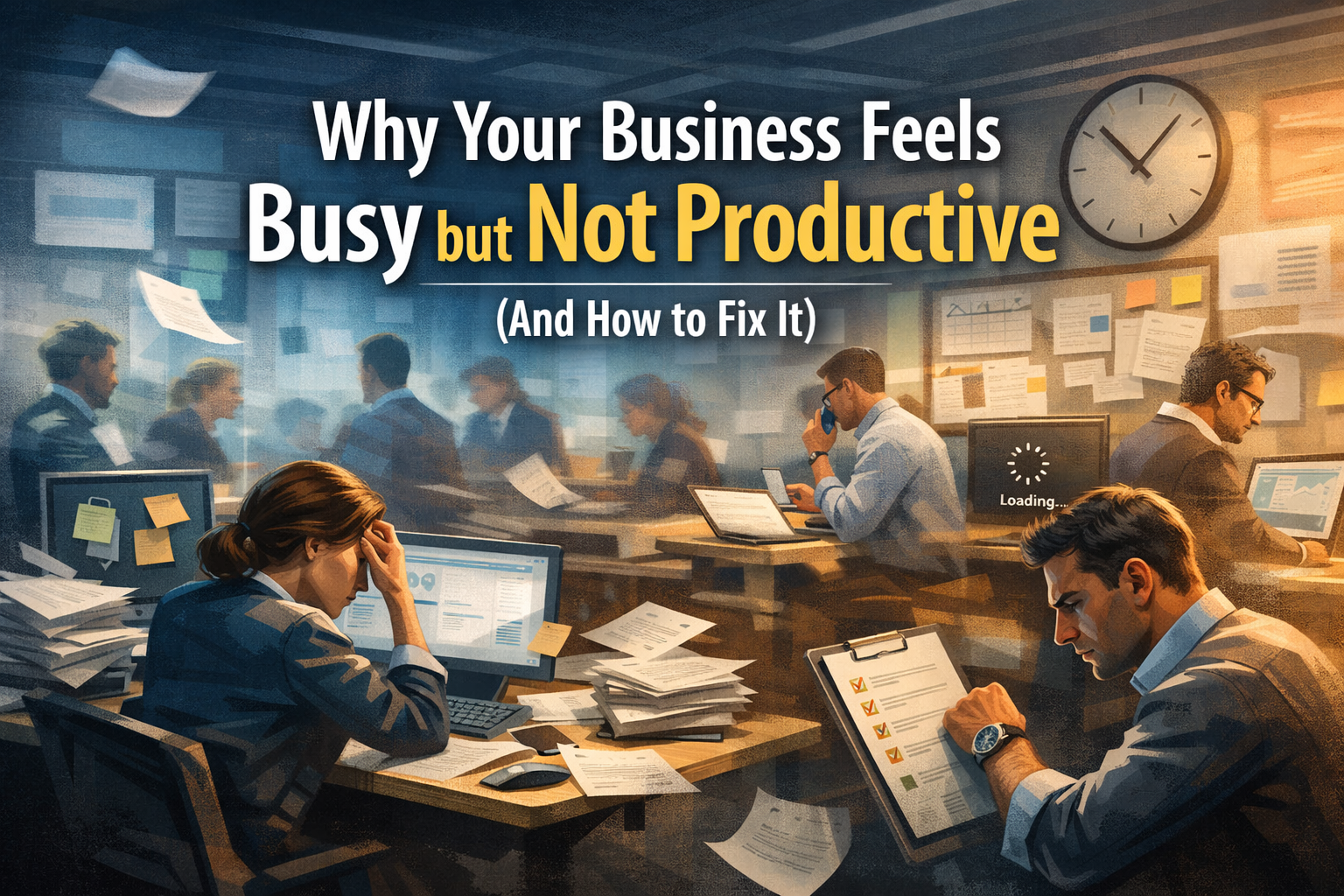
There is a familiar pattern that emerges in many growing organizations.
On the surface, everything appears to be working. Teams are active, calendars are filled with meetings, communication is constant, and work is moving across the organization at a rapid pace. From the outside, it looks like a highly productive environment.
And yet, internally, a different reality often exists.
Despite the volume of activity, progress feels slower than expected. Projects take longer to complete, decisions are delayed, and outcomes do not seem to match the level of effort being invested. Teams feel stretched, but the business is not advancing at the pace it should.
This disconnect creates a frustrating dynamic—one in which the organization is working harder than ever, but not necessarily moving forward more effectively.
In most cases, this is not a productivity problem.
It is an operational one.
The Illusion of Productivity
Many organizations equate activity with productivity.
They look at the number of meetings being held, the volume of tasks being completed, and the level of engagement across communication channels. From that perspective, it appears that the business is operating efficiently.
However, activity alone does not drive meaningful progress.
A team can be constantly engaged in work and still fail to produce outcomes that move the business forward in a significant way. When productivity is measured primarily through activity, organizations begin to optimize for being busy rather than being effective.
Over time, this creates an illusion of progress. Work is happening, but it is not always aligned with what actually matters.
How Growing Companies Drift Into This State
In the early stages of a business, speed is the primary advantage.
Teams are small, communication is direct, and decisions are made quickly. Work gets done through informal coordination, and there is little need for structure. This environment allows for rapid execution and adaptability.
As the business grows, however, complexity increases.
More employees are added, new tools are introduced, and processes begin to take shape. What was once handled through direct communication now requires coordination across multiple people and functions.
To manage this complexity, organizations introduce mechanisms intended to improve alignment—regular meetings, status updates, reporting structures, and internal communication systems.
While these are necessary to some extent, they often expand beyond their intended purpose.
Over time, coordination begins to replace execution.
Instead of enabling work, these structures begin to consume the time and attention of the teams they were meant to support.
Where Productivity Breaks Down
The underlying issue is not a lack of effort, but a lack of system design.
As organizations grow without intentionally structuring how work flows, inefficiencies begin to emerge in several areas.
Work often becomes fragmented, moving inconsistently between teams and stages of execution. Tasks are delayed by dependencies, duplicated across functions, or slowed down by unclear ownership. Rather than progressing smoothly, work requires constant intervention to keep moving.
At the same time, employees are frequently forced to operate across multiple systems, tools, and priorities. This leads to continuous context switching, which reduces the ability to focus deeply on any one task. Even small interruptions accumulate, diminishing overall productivity.
Another common issue is the absence of clearly defined priorities. When teams are not aligned on what matters most, everything begins to feel urgent. This results in reactive work, where effort is directed toward immediate demands rather than strategic objectives.
In many cases, these challenges are compounded by manual processes that have not evolved with the business. Tasks such as reporting, data entry, and coordination continue to consume time, even as the organization scales.
Individually, these issues may appear manageable.
Collectively, they create an environment where productivity is constrained by the system itself.
The Hidden Costs of Busyness
While a busy organization may appear to be thriving, sustained inefficiency introduces real and measurable costs.
One of the most immediate impacts is the loss of time. Teams spend a significant portion of their day coordinating work rather than executing it. Meetings expand, communication increases, and the time available for focused work decreases.
Decision-making also becomes slower. When alignment requires multiple discussions and data must be interpreted across systems, even routine decisions take longer than they should.
Inconsistency is another consequence. Without standardized processes, outcomes vary depending on who is performing the work. This lack of predictability makes it difficult to scale performance across the organization.
Over time, these inefficiencies begin to affect morale. High-performing individuals often become frustrated when they are unable to operate effectively within the system. What begins as a structural issue can eventually lead to burnout and disengagement.
Why Adding More Tools Doesn’t Solve the Problem
When organizations recognize that productivity is declining, their instinct is often to introduce new tools.
Additional platforms are implemented to improve communication, track work, or generate insights. While each tool may provide value in isolation, the overall system becomes increasingly complex.
Every new tool introduces another layer of coordination, another source of data, and another place where work must be managed.
Without intentional integration, this approach leads to fragmentation rather than clarity.
Instead of simplifying operations, technology can amplify existing inefficiencies.
Shifting From Activity to Output
Addressing this issue requires a fundamental shift in perspective.
Organizations must move away from measuring activity and begin focusing on output.
Output is defined not by the amount of work performed, but by the impact that work has on the business. It reflects meaningful progress toward strategic goals rather than the completion of isolated tasks.
Achieving this shift requires a more structured approach to how work is designed and executed.
What Effective Operations Look Like
In a well-structured organization, work flows in a predictable and efficient manner.
Processes are clearly defined, allowing tasks to move from one stage to the next without unnecessary delays. Ownership is established, ensuring that responsibilities are understood and accountability is maintained.
Systems are integrated in a way that supports execution rather than hindering it. Information is accessible when needed, and teams do not need to navigate multiple disconnected tools to complete their work.
Priorities are aligned across the organization, reducing the need for constant recalibration. Teams understand what matters most and are able to focus their efforts accordingly.
Perhaps most importantly, there is a clear connection between effort and outcome. Work performed by teams leads directly to measurable progress, creating a sense of momentum and clarity.
A More Intentional Approach to Improving Productivity
Improving productivity is not about increasing effort. It is about improving the system within which that effort takes place.
This begins with simplifying workflows. By identifying where work becomes delayed, duplicated, or unnecessarily complex, organizations can remove friction and create a more efficient flow of execution.
Reducing coordination overhead is also essential. Not every task requires a meeting or discussion. By limiting unnecessary communication, teams can dedicate more time to focused work.
Clarifying priorities ensures that effort is directed toward the most impactful areas of the business. When priorities are well-defined, teams are able to make decisions more quickly and with greater confidence.
Automation can further enhance efficiency by eliminating repetitive tasks that do not require human input. This allows employees to focus on higher-value activities that contribute directly to business outcomes.
Finally, integrating systems reduces fragmentation. When tools and data are connected, work becomes more seamless and less dependent on manual intervention.
The Role of Leadership
The structure of an organization’s operations is ultimately shaped by its leadership.
Leaders determine what is prioritized, how decisions are made, and how work is evaluated. If leadership emphasizes activity, teams will naturally focus on being busy. If leadership emphasizes outcomes, teams will align their efforts accordingly.
Creating a productive organization requires deliberate choices at the leadership level. It requires a commitment to clarity, simplicity, and alignment.
The Advantage of Operational Focus
In an environment where many organizations are overwhelmed by activity, those that prioritize clarity gain a distinct advantage.
They are able to move more quickly because their systems support decision-making. They execute more consistently because their processes are defined and repeatable. They scale more effectively because their operations are designed with growth in mind.
This advantage is not the result of working harder.
It is the result of working more intentionally.
Final Thoughts
When a business feels busy but not productive, the issue is rarely a lack of effort.
More often, it is a reflection of how the organization is structured.
Without clear systems, aligned priorities, and integrated workflows, even the most capable teams will struggle to operate efficiently.
The solution is not to increase activity.
It is to redesign the system.
Because in the end, productivity is not measured by how much work is being done.
It is measured by how much progress is being made.
And the organizations that understand this distinction are the ones that are able to move forward with clarity and scale with confidence.